
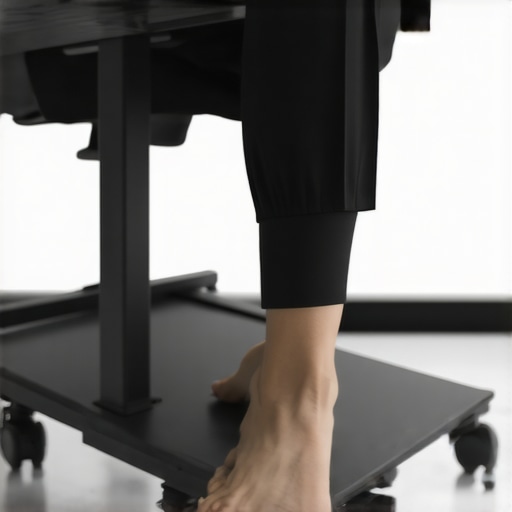
I used to think I was just getting old or maybe I just wasn’t ‘built’ for office life. Every day around 3:00 PM, a dull, throbby ache would set up camp in my L5-S1 region. I’d squirm, I’d stretch, and I’d curse the day I ever heard the word ‘spreadsheet.’ I even bought one of those mesh chairs that costs more than my first car, thinking it would be my salvation. Guess what? The pain didn’t budge. It wasn’t until I had a lightbulb moment while propping my feet up on a stack of printer paper that I realized the truth. My legs were just a few inches too short for my desk height, and by letting my feet dangle or tucking them back, I was dragging my pelvis into a permanent tilt. This minor misalignment was the secret culprit behind my daily misery. Today, I’m going to show you exactly why that expensive desk chair might be giving you false sciatica simply because your feet aren’t planted.
Your floor is further away than you think
For years, I made the classic mistake of ‘perching’ on the edge of my seat with only my tiptoes touching the floor. I thought I was being active. In reality, I was starving my lower back of stability. When your feet don’t have a solid, flat surface to press against, your center of gravity shifts forward. Your lower back muscles then have to pull double duty just to keep you upright. It’s a recipe for disaster. By unlocking better posture through foot support, you take the ‘brakes’ off your spine. Have you ever found yourself wrapping your feet around the legs of your chair just to feel ‘stable’? Tell me I’m not the only one who did this for years!
Is a plastic wedge actually worth the hype?
You might be skeptical. I certainly was. It feels a bit like a gimmick, right? But the science is surprisingly solid. According to ergonomics research from Cornell University, sitting without foot support can increase pressure on the lumbar discs by up to 40% compared to sitting with feet flat and thighs parallel to the floor. This is because a footrest acts as a chair hack to keep your pelvis neutral. Without it, your hamstrings can actually pull on your ‘sit-bones,’ flattening your lumbar curve and causing those deep, nagging spasms we all hate.
Give your hip flexors a much-needed break
One thing nobody tells you is that when your feet are dangling, your hip flexors stay ‘on’ all day. They are constantly firing to keep your legs in place. Because your hip flexors are attached directly to your lumbar vertebrae, they end up yanking on your spine from the inside out. Using a footrest allows these muscles to finally go slack. It’s the same principle as the simple pelvic tilt that makes sitting for hours painless. When I finally committed to using a proper footrest, that ‘tight’ feeling in my hips disappeared within a week. I’m going to walk you through the specific angles and heights you need to look for, but first, you have to accept that your feet are the foundation of your spinal health.
Find Your Magic Angle for Pelvic Relief
To get this right, you need to treat your chair-desk-floor setup like a tripod. If one leg is off, the whole thing wobbles. Start by adjusting your chair height so your elbows are level with your keyboard. Most people do this and then realize their feet are dangling. This is where the footrest comes in. You aren’t just looking for a platform; you’re looking for a specific tilt. Aim for about 15 to 20 degrees of incline. This slight slope helps perform a natural psoas release that finally stops your deep lower back ache because it prevents your pelvis from tucking under. I remember my first week trying this—I used a stack of old textbooks taped together. It was ugly, and my cat eventually shredded the tape, but for those three days, the burning in my SI joint actually paused.
Why Your Thighs Need to Slope Downward
The goal isn’t necessarily to have a perfect 90-degree bend at the knees. In fact, many physical therapists now suggest a ‘hip-open’ posture where your knees are slightly lower than your hips. When your knees are higher than your hips, you’re basically in a crunch position all day, which is why your sitting habits are causing your hamstrings to tighten and pull on your lower back. Use the footrest to support the balls of your feet, allowing your heels to rest firmly. This creates a stable base that lets you engage your core without even thinking about it.
Keep Your Ankles Moving to Save Your Spine
Don’t treat your footrest like a concrete block. The best models have a ‘rocking’ feature. This isn’t just a fidget-spinner for your feet; it’s a vital tool for circulation. When you rock your feet back and forth, you’re using the ‘calf pump’ to move blood back up to your heart. More importantly, this micro-movement serves as a hidden nerve trick to stop leg tingling while sitting at your desk. Static posture is the enemy of spinal health. I once tried to sit perfectly still for four hours on a ‘perfect’ ergonomic stool, and I ended up so stiff I could barely stand up to get water. Contrast that with the correct way to use a standing desk without hurting your feet, which emphasizes weight shifting. Your sitting setup should mirror that same philosophy of movement.
The Hard Surface vs Memory Foam Debate
You might be tempted by those plushy, cloud-like foam footrests. Be careful. If the foam is too soft, your feet will sink in, and you’ll lose the structural support needed to keep your pelvis neutral. You want something firm enough to push against. Think of it like a mattress—if it’s too squishy, you wake up with a kink in your neck. If you have a firm base, you can occasionally use a tennis ball on top of it to roll out your plantar fascia, which further relaxes the entire posterior chain of your body. It sounds disconnected, but a tight foot often equals a tight back.Most people think that if a muscle feels tight, the solution is to pull on it until it gives up. This is where most mobility routines fail spectacularly. If you’ve been religiously touching your toes every morning but your lower back still feels like it’s made of dry kindling, you’re likely falling for the most common myth in ergonomics: the idea that more flexibility always equals less pain. In reality, your brain often tightens your muscles as a parking brake to protect a spine it perceives as unstable. If you force those muscles to relax without addressing the underlying stability, your brain will just slam the brakes on harder the next time you move. This is exactly why stretching your hamstrings might be making your back pain worse. You aren’t releasing tension; you’re annoying an already irritated sciatic nerve.
The hidden trap of protective tension
When your pelvis is out of alignment—perhaps from that dangling-foot habit we talked about—your body uses the hamstrings and glutes to bolt the pelvis to the spine. A study published in the Journal of Orthopaedic & Sports Physical Therapy highlights that what patients perceive as tightness is frequently neural tension, not muscle shortness. If you have true sciatica, stretching is like pulling on both ends of a frayed electrical wire. Instead of a deep stretch, you need a nerve glide that calms sciatica pain in seconds by allowing the nerve to slide through its sheath rather than being yanked. I see this oops factor constantly: people using posture braces to force a shape their muscles can’t support, which only leads to more atrophy and deeper instability.
Does your tightness disappear when you change your neck position?
This is the ultimate litmus test for advanced mobility. If you feel a stretch in your calf or hamstring while sitting, try tucking your chin to your chest. If the intensity in your leg increases, you aren’t stretching a muscle; you’re pulling on your entire spinal cord. This is a classic sign of neural involvement and a cue that you need to stop the aggressive stretching immediately. You might think you need a deeper yoga pose, but you actually need to understand how to tell if your sciatica is coming from your piriformis or a disc issue before you do another rep. Have you ever fallen into this trap of stretching a tight spot only to have it feel tighter an hour later? Let me know in the comments, because I spent three years doing exactly that before I learned better.
Why core strength is often a lie
Another nuance we need to tackle is the obsession with core strength. Most people think they need a six-pack to protect their back. But for spinal health, stiffness and endurance are far more important than raw strength. You don’t need to do 100 crunches; you need to master the deep core connection that stops your spine from shear stress. Over-active outer abs can actually crush your lumbar discs if they aren’t balanced by the deep stabilizers. It’s about the bracing reflex, not the muscle size. If you’re ready to stop the generic advice and start looking at your body as a system of levers and pulleys, we can finally get you past that 3:00 PM wall.I’ve spent thousands of hours and probably too many dollars testing every ergonomic gadget under the sun. What I’ve learned is that the best tools don’t do the work for you; they force you to stay honest about your movement. For me, that meant ditching the flat standing mat for a topographical one. These mats have hills and valleys that force your feet to constantly shift, which is the best way to transition from a sitting to a standing desk without developing those dreaded ‘standing-still’ aches. If you’re still using a laptop on a flat table, stop. I follow a strict 2-inch rule for your laptop stand to keep my eye line from dragging my cervical spine into a forward slump.
How do I keep my back healthy in the long run?
Maintenance isn’t a weekend project; it’s a series of ‘movement snacks.’ I’ve found that even the most expensive setup fails if you stay static. According to the BIFMA G1-2013 Ergonomics Standard, the range of adjustability in your furniture is more important than any single fixed position. This is why I prefer chairs with 4D armrests and height-adjustable lumbar support. To stay consistent, I’ve integrated a morning routine to decompress your spine before coffee. It’s non-negotiable. I predict that in the next five years, we’ll see ‘active’ furniture—desks and chairs with haptic sensors that gently vibrate when they detect your pelvis tilting into a dangerous ‘slump’ position, effectively automating posture correction secrets in real-time. For now, your best tool is awareness. Don’t just sit there; interact with your environment. If you want to see an immediate change, I challenge you to try the 30-second wall reset right now. Your shoulders will thank you before you even finish the stretch.
Lessons That Saved My Spine When High-End Chairs Failed
I used to believe that throwing money at a chair would solve my problems, but the real breakthrough came from understanding that posture is a dynamic conversation between your body and the floor. Here are the lightbulb moments that finally changed my trajectory:
- The ‘Passive’ Trap: I realized that leaning into lumbar supports without engaging my feet was actually making my muscles lazy. True mobility mastery involves active stabilization from the ground up.
- Neural Tension vs. Muscle Tightness: I spent years stretching my hamstrings when the problem was actually a frustrated sciatic nerve. Learning the difference between a muscle pull and a nerve tug saved me months of wasted effort.
- Movement Over Form: A ‘perfect’ posture held for eight hours is just as damaging as a bad one. The goal isn’t to sit still; it’s to create an environment where shifting is easy and supported.
- The Arch Connection: I never connected my flat feet to my lower back until I saw how the foot arch connection to your chronic lower back spasms dictates the tilt of the pelvis.
Equipment I Actually Use to Stay Pain-Free
You don’t need a warehouse full of gadgets, but you do need tools that respect your anatomy. These are the staples in my home office that I recommend to everyone:
- Topographical Standing Mats: Unlike flat mats, these have calculated ‘bumps’ that keep your ankles moving. This is my favorite way to master your mobility while taking calls.
- Firm Incline Footrests: Forget the memory foam versions; they sink and lose their corrective angle. Go for plastic or wood to ensure your pelvis stays in that neutral ‘sweet spot.’
- Tennis Ball for Release: I keep one on my footrest to roll out my soles. It sounds simple, but relaxing the fascia in your feet is one of those daily spinal alignments for lasting relief that most people ignore.
Stop Waiting for the Perfect Moment to Fix Your Back
The transition from constant ache to effortless focus doesn’t happen overnight, but it does happen the moment you stop accepting pain as your ‘normal.’ By making small, daily adjustments to alleviate back pain and improve posture, you are literally changing the mechanical load on your spine. Don’t wait until you can afford a $2,000 desk setup to start caring for your L5-S1. Use a stack of books, a tennis ball, or a simple wall reset today. Your future self will thank you for the relief you chose to build right now. Have you ever tried using a footrest and felt an immediate shift in your lower back pressure? Let me know your experience in the comments below!