

I woke up last Tuesday, reached for my phone, and felt a lightning bolt shoot from my ear down to my shoulder blade. I couldn’t even turn my head to see who was texting. It is that classic, ‘I guess I live like a statue today’ feeling. If you have ever had to rotate your entire torso just to look at someone speaking to you in the grocery store, you know exactly what I am talking about. For years, I thought I was just getting older or that I needed some high-tech ergonomic gear to survive the night. I even tried those expensive memory foam contour pillows that look like blue waves, but they mostly just gathered dust while my neck continued to scream every morning. The truth is, the answer was sitting in my linen closet the whole time. Today, we are going to fix that ‘rust’ in your cervical spine using nothing but a standard bathroom towel.
Stop fighting your pillow and start fixing your curve
The real reason we wake up feeling like our neck is made of dry wood isn’t just about sleeping in a weird position. It is about support—or the lack of it. Most pillows, even the fancy ones, fail to maintain the natural C-curve of your neck throughout the night. I spent way too much money trying to buy my way out of the problem before I realized that your pillow choice is often the hidden culprit behind that 6 AM agony. According to experts at Harvard Health Publishing, keeping your head in line with your spine is the golden rule for avoiding morning strain. When your head is pushed too high or falls too low, those small muscles in your neck work overtime to stabilize you while you sleep. By the time you wake up, they are exhausted and locked in a protective spasm.
Is a rolled-up towel really better than a $100 orthopedic pillow?
It sounds too simple to be effective, doesn’t it? I was the biggest skeptic on the block. I figured if it didn’t cost a fortune and come with a 50-page manual, it probably wouldn’t work for my ‘unique’ pain. But here is the thing: a towel is infinitely customizable. You can roll it to the exact thickness your specific spine needs. Have you ever felt like no matter how you fluff your pillow, there is still a hollow gap under your neck? That gap is exactly where your muscles go to work when they should be resting. A simple towel roll fills that void perfectly, allowing your nervous system to finally stand down.
The painful mistake I made that kept me stiff for years
In my early days of dealing with this, I made a massive error that I see people repeating every day. I used to think that if my neck felt tight, I needed to force it to move to find relief. I would grab my chin and jerk my head to the side, hoping for that satisfying pop. It felt good for about ten minutes, but then the stiffness would come back even harder than before. I didn’t realize back then that self-cracking your neck actually makes the stiffness return faster because it destabilizes the very joints you are trying to help. It is a vicious cycle that leads to more inflammation and longer recovery times. Instead of forceful movements, I started focusing on a morning routine to decompress my spine before I even took my first sip of coffee. Have you ever found yourself caught in that cycle of quick-fix cracking? It is a hard habit to break, but the towel trick provides the structural support that makes that urge disappear by addressing the root cause. We are about to look at exactly how to fold, roll, and place this magic towel to ensure you never wake up feeling like a gargoyle again.
Let’s turn that bathroom staple into a structural support system
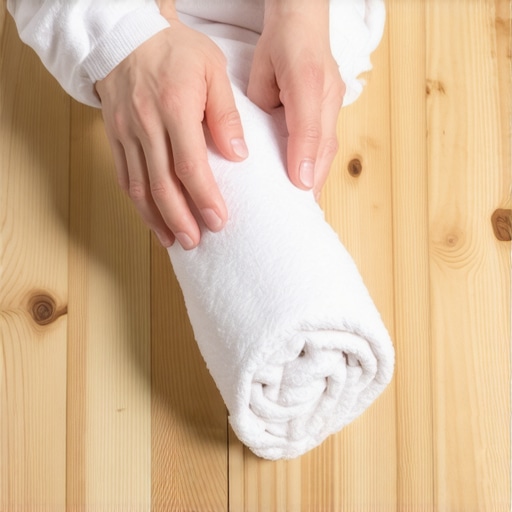
You don’t need a degree in biomechanics to get this right, but you do need to stop treating your towel like a random lump of fabric. Think of your neck as a bridge. If the middle of the bridge doesn’t have a support beam, it eventually sags and cracks. The towel roll is that beam. To start, you need a standard hand towel—not a washcloth (too small) and definitely not a bath towel (too bulky). Fold it in half lengthwise so you have a long, thin strip. Now, roll it up as tightly as possible. You want it to feel firm, like a dense foam roller, not squishy like a marshmallow.
The burrito roll technique
Precision is everything here. If the roll is too loose, it will flatten out the second you lay your head down, rendering it useless. I remember the first time I tried this; I used a plush, oversized bath towel. I felt like I was being forced into a permanent ‘look at the ceiling’ pose. Within ten minutes, my teeth started to ache—it turns out that a tight jaw leads to chronic upper neck pain when your head is tilted back too far. I had to unroll it, swap for a thinner hand towel, and start over. The goal is a cylinder that is roughly three to four inches in diameter, depending on the length of your neck.
Nailing the placement every single time
Once you have your ‘burrito,’ the magic happens in the placement. You aren’t putting this under your head. If your skull is resting on the towel, you’ve missed the mark. The roll needs to sit directly in the hollow of your neck, supporting the cervical spine while your head rests on the actual bed or a very thin pillow. When you lay back, you should feel an immediate ‘sigh’ from your muscles. It should feel like someone is gently holding your neck up, allowing your shoulders to finally drop away from your ears. If you are a side sleeper, you can still use this; just tuck the roll into your pillowcase to keep it from sliding away. This is one of those side sleeper pillowing tricks for optimal spine alignment that saves people from that one-sided morning kink.
Adjusting the density for your unique spine
Not every neck is built the same, so don’t be afraid to tweak the roll. If it feels like it is pushing your head forward, unroll a few inches. If you still feel that ‘hollow’ gap, roll it tighter or use a slightly thicker towel. You have to adjust your routine daily until you find the goldilocks zone. For the first few nights, you might only tolerate it for twenty minutes before your body wants to shift. That is normal. Your ligaments are literally being gently guided back into a shape they haven’t held in years. Over time, this becomes a foundational habit to enhance your mobility and stop the cycle of waking up in a defensive crouch.
While the towel roll addresses the physical gap under your neck, we need to talk about why your body created that tension in the first place. Most of us have been taught that if something feels tight, we should stretch it until it yields. I spent years aggressively pulling on my muscles, thinking I was just a ‘naturally stiff’ person who needed more intensity. But here is the contrarian truth that most beginners miss: stiffness is often a protective mechanism, not a lack of flexibility. When your brain senses instability in the spine, it sends a ‘lockdown’ signal to the surrounding muscles to prevent injury. This is known as neuromuscular guarding. If you try to stretch through that guarding, your brain just pulls back harder. It is like trying to open a locked door by pulling the handle harder; you aren’t fixing the lock, you are just straining the hinges. Instead of forcing length, you must enhance flexibility by convincing your nervous system that the joint is safe.
Your brain is the one actually locking your joints
I have seen so many people trigger a massive spasm simply because they tried to ‘lengthen’ a muscle that was actually holding their spine together. A study published in the Journal of Bodywork and Movement Therapies suggests that static stretching can actually decrease joint stability if the underlying issue is structural rather than purely muscular. When you feel that ‘deep’ ache, your body might be asking for stability, not more range of motion. This is where how your breathing pattern keeps your back muscles guarded becomes a critical piece of the puzzle. If you are breathing high in your chest, you are telling your nervous system you are in a ‘fight or flight’ state, which keeps those neck muscles in a permanent state of high alert. No amount of stretching will override a brain that thinks it is under attack.
#IMAGE_PLACE_HOLDER_C#
Why does my spine feel ‘locked’ even after I move?
The answer usually lies in what I call the ‘compensation trap.’ When one part of your spine is stuck, another part has to move twice as much to make up for it. This creates a cycle where the moving part gets hyper-mobile and irritated, while the stuck part stays glued shut. This is a common mistake I see with lower back issues too. People will spend twenty minutes a day stretching their hamstrings, unaware that you should stop stretching your hamstrings for back relief because those tight muscles are often actually acting as a brake for a pelvis that is out of alignment. If you stretch that brake away without fixing the alignment, you leave your lower back vulnerable to shear stress. It is the same reason why the 90-90 hip stretch mistake is so prevalent; if you don’t stabilize your core first, you are just wrenching on your lumbar discs.
The hidden danger of the ‘perfect’ posture look
Another nuance that people get wrong is the idea of ‘standing up straight.’ Most people respond to this by sucking in their stomach and pinning their shoulders back. This is actually a disaster for your spine. When you do this, you create immense pressure on your internal organs and kill your natural shock absorption. I always tell my clients to stop sucking in your stomach to look thinner because it shuts off the deep core connection that stops your spine from shear stress. Real posture isn’t a rigid pose; it is a dynamic state of ease. To truly unlock better back health, you have to stop trying to look like a soldier and start focusing on stackable alignment. Have you ever fallen into this trap of over-stretching or forcing ‘perfect’ posture only to feel stiffer the next day? Let me know in the comments, and let’s figure out where your body might be guarding instead of resting.
If you’re waiting for a high-tech miracle gadget to arrive in a cardboard box, let me save you some money and a lot of frustration. I’ve gone through the vibrating massage guns and the electronic neck stretchers that look like something out of a sci-fi movie, but they usually just end up in the ‘junk drawer of regret.’ I’m a big believer in low-tech solutions that you can actually stick to without needing an outlet or a charging cable. In my personal kit, the most valuable player is a simple tennis ball. I use it to target the fascia in my feet every single evening because your foundation dictates what happens at your neck. You can learn how to use a tennis ball to release tension in your feet and back to stop those spasms before they climb your spine. I also keep a firm foam roller nearby, but I’m incredibly picky about how I use it. Most people just roll back and forth like a rolling pin on dough, but the secret is finding the specific stiff segment and breathing into the pressure. Mastering the proper way to use a foam roller on your upper back changed the game for my thoracic mobility and finally stopped that mid-back ‘burning’ sensation. 
How do I make these postural wins stick for the long haul?
The answer isn’t in a one-time fix or a monthly appointment; it’s in the micro-adjustments you make while you aren’t even thinking about your back. This is what I call ‘spinal hygiene.’ For example, I follow the 2-inch rule for your laptop stand to save your neck from strain. It sounds like a minor detail, but that tiny lift prevents the ‘forward head carriage’ that makes the towel trick necessary in the first place. If you don’t fix the environment, the towel is just a temporary bandage. Dr. Stuart McGill, author of Back Mechanic and a world-renowned authority on spine biomechanics, suggests that the key to a pain-free life is building ‘proximal stiffness’ to allow for distal mobility. This means your core needs to be the stable anchor so your neck and hips can be the fluid pivots. To really see results that last beyond the weekend, you must adjust your routine daily spinal alignments for lasting relief. I predict that in the next few years, we’ll see a massive shift toward AI-integrated workspace sensors—think wearable clips or camera software—that nudge us the second our cervical curve collapses, but for now, we have to be our own sensors. These posture correction secrets that transform back pain outcomes only work if you stay consistent with the small stuff. I want you to try one thing before you close this tab: get against a flat wall and perform the wall angel move that reverses a day of hunching over a phone for just 30 seconds. It will feel like a workout for your upper back, but it’s the fastest way to unlock better back health and remind your nervous system where ‘home’ is for your shoulder blades. Consistency beats intensity every single time.
The Hardest Lessons I Learned on the Road to Lasting Mobility
When I first started this journey, I thought I was a ‘stiffness’ case that required brute force. I was wrong. The biggest lightbulb moment for me was realizing that my body wasn’t failing; it was protecting itself. I learned that how to tell if your dizziness is coming from your neck is often the first step in realizing just how much your cervical spine influences your entire nervous system. If you ignore the subtle signals, your brain will eventually turn up the volume. Another truth? You can’t stretch your way out of a bad environment. If you spend eight hours in a ‘C’ shape and five minutes stretching, the chair always wins. That is why I started focusing on posture correction secrets that transform back pain outcomes by changing my workspace first, rather than just my gym routine.
The Essential Tools for a Pain-Free Home Setup
I don’t believe in cluttering your home with plastic gadgets, but a few specific items are non-negotiable for me. First, a firm hand towel for the neck roll we discussed—it is the simplest way to unlock better back health while you sleep. Second, the book Back Mechanic by Dr. Stuart McGill. It changed how I view ‘core strength’—it is not about sit-ups; it is about stability. I also swear by a standard tennis ball for my feet. It sounds strange, but releasing the fascia in your soles can actually lower the ‘threat’ level in your entire posterior chain. Finally, ensure you are practicing daily adjustments to alleviate back pain and improve posture to keep the momentum going.
Your Spine Deserves More Than Just a Quick Fix
Recovery isn’t a straight line, and there will be mornings where you still feel a bit of that old ‘rust.’ Don’t let it discourage you. The goal is to build a body that is resilient enough to handle a bad night’s sleep or a long flight without collapsing. By using the towel trick and incorporating the wall angel move that reverses a day of hunching over a phone, you are giving your nervous system the safety it needs to let go of the guard. You have the tools now to enhance your mobility for years to come. Remember, the best time to start was yesterday, but the second-best time is tonight when you lay your head down. Have you ever tried a neck roll before, or are you currently struggling with a pillow that feels like a brick? Let me know your experience in the comments below!