
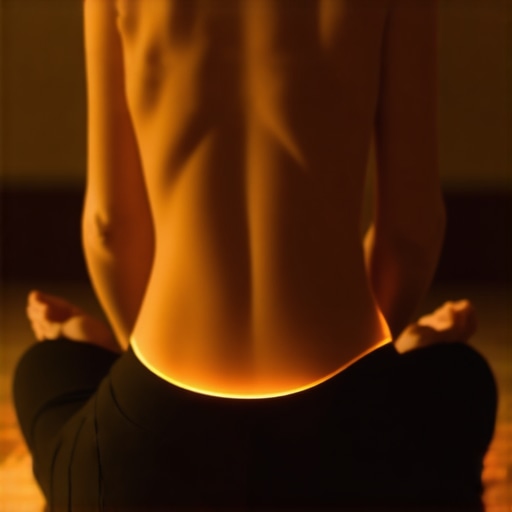
I’ll never forget the Tuesday my back finally gave up on me. I wasn’t lifting a heavy box or running a marathon; I was reaching for a lukewarm cup of coffee. Pop. That familiar, searing tightness grabbed my lower spine and wouldn’t let go. For years, I’d been told to breathe deeply to relax, but every time I did, my shoulders hit my ears and my lower back felt even more compressed. I realized I was breathing like a stressed-out bird—all chest, no base. I was starving my lower lumbar of the very internal pressure it needed to stay stable.
Stop Pushing Your Belly Out and Start Feeling Your Spine
When I first started trying to fix my posture, I made a classic mistake: I thought core strength meant bracing my abs like I was about to take a punch. In reality, you should stop sucking in your stomach to look thinner because it actually locks your diaphragm in a cage. I was essentially suffocating my spine from the inside out. Today, I’m going to show you how to direct that air downward—not into your belly, but into those tight muscles flanking your spine. We’re going to turn your breath into a hydraulic jack that lifts the pressure off your discs.
Is this just more mindful fluff that doesn’t actually work?
I get it. When your back is screaming, breathing sounds about as effective as wishing the pain away. But here’s the science: the diaphragm isn’t just for air. According to research published in the Journal of Biomechanics, the diaphragm serves as a critical postural stabilizer that helps manage intra-abdominal pressure. If you aren’t using it correctly, your lower back muscles have to work double-time just to keep you upright. This is exactly why the deep core connection that stops your spine from shear stress is impossible to achieve if your breath is stuck in your throat. Does your lower back feel like it’s made of dried leather every time you try to inhale deeply? Have you noticed that the harder you try to sit up straight, the more your back aches by 3 PM? If so, you’re not alone—I spent three years doing the same thing before I learned how to expand my ribs and back properly. This isn’t about relaxation; it’s about mechanical decompression. Once you learn how to breathe through your ribs to ease lower back tension, the stuck feeling in your lumbar starts to dissolve.
Breathe Into Your Back Like an Expanding Balloon
To stop the cycle of compression, you have to change where the air goes. Think of your torso as a pressurized canister. Most people only expand the front of the canister, which causes the spine to arch and the lower back muscles to seize up. To fix this, you need to find your lateral and posterior ribs. Place your hands on the sides of your waist, just above your hip bones. As you inhale, try to push your hands out sideways. You aren’t just filling your belly; you are widening your frame. This creates a natural internal support system that rivals any store-bought brace. When you master this, you realize why your core strength isn’t stopping your back aches—it’s because you were bracing against the pain rather than supporting the structure with pressure.
Widening the Ribs Instead of Lifting the Shoulders
If your collarbones move up when you inhale, you are using your neck to breathe. This is a primary driver of tension. Instead, imagine your lower ribs are like a bucket handle. On the inhale, that handle should swing outward and upward away from your spine. This mechanical shift creates space in the lumbar region. I remember sitting at my desk three years ago, trying this for the first time. I was so used to sucking my gut in that my ribs felt glued together. I spent ten minutes just trying to get my right lower rib to budge. When it finally moved, I felt a literal ‘thud’ of relaxation in my SI joint. It wasn’t a crack like a chiropractor gives, but a release of pressure that had been building for months. This is the secret to strengthening your deep core without sit-ups or heavy lifting. 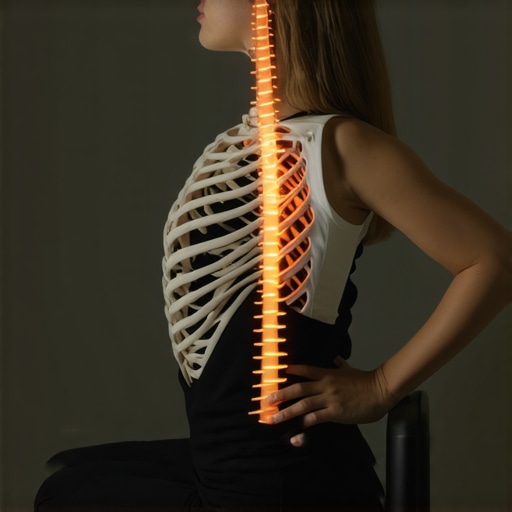
Find Your Natural Neutral Without Stiffening Up
Most of us overcorrect. We hear ‘stand up straight’ and we throw our shoulders back and arch our lower backs, which actually pinches the nerves. To find a safe neutral, sit on a hard chair and find your ‘sit bones.’ Rock your pelvis forward and back until you feel you are balanced right on top of them. Once you are there, use that 360-degree breath to fill the space in your lower back. If you feel your lower back flattening slightly against the back of your chair, you’ve hit the sweet spot. This is the foundation of mastering your mobility and moving without pain.
The Chair Hack for Long Work Days
If you struggle to maintain this while typing, you need to change the geometry of your seat. Use the chair hack to keep your pelvis neutral while working by slightly angling your knees below your hips. This opens the hip flexors and makes it physically easier for the diaphragm to drop down. When I started doing this, I noticed I no longer had that ‘stuck’ feeling when I stood up after an hour of emails. I wasn’t just sitting; I was using my breath to actively decompress my spine while I worked. This proactive approach is far more effective than waiting until 5 PM to try and stretch out the damage. To truly see results, you have to adjust your routine with daily spinal alignments that prioritize this internal pressure over external stretching.
The Dangerous Trap of the ‘Tight’ Muscle Illusion
For years, I was convinced that my lower back felt like a guitar string because my muscles were ‘too short.’ I spent twenty minutes every morning aggressively reaching for my toes, thinking that more flexibility was the golden ticket to a pain-free life. I was wrong. In fact, why stretching your psoas might actually be making your back hurt more is a nuance most people miss: that ‘tight’ feeling is often your nervous system’s way of creating stability because your core isn’t doing its job. When you stretch a muscle that is already overextended or protecting a joint, you’re essentially pulling on a rope that’s already at its breaking point.
Why does your back feel stiffer after you try to ‘fix’ it with stretching?
It sounds counterintuitive, but many of the people I talk to experience a temporary ‘stretch high’ followed by an even deeper ache a few hours later. This happens because you are temporarily numbing the pain receptors in the muscle, but you aren’t addressing the underlying structural instability. According to research published in the Journal of Bodywork and Movement Therapies, over-stretching without functional stability can lead to micro-instability in the lumbar spine. This is why posture correction secrets that transform back pain outcomes focus more on bracing and internal pressure than they do on extreme flexibility. You don’t need to be a contortionist; you need to be a solid pillar.
Stop Stretching Your Psoas Into Oblivion
One of the biggest ‘oops’ factors I see—and one I fell for myself—is the obsession with the hip flexors. We sit all day, our hips feel tight, so we lunge until we feel a burn. But if your pelvis is already tilted forward, you are likely just jamming your hip joint and stressing the labrum rather than lengthening the muscle. I’ve found that the 90-90 hip stretch mistake that is hurting your lumbar spine is a classic example of doing ‘the right thing’ in ‘the wrong way.’ Instead of forcing length, we should be focused on mobility mastery and simple exercises to relieve chronic back pain that prioritize joint centration. This means keeping the ball of your hip deep in the socket while you move, rather than letting it slide forward and pinch the nerves.
The Myth of the ‘Perfect’ Ergonomic Chair
We’ve been sold the lie that if we just spend $1,200 on a chair with a mesh back, our pain will vanish. The truth is that even the best chair becomes a cage if you don’t move. In my experience, why your expensive desk chair might be giving you false sciatica often comes down to how it encourages you to ‘slump’ into the support. You stop using your own muscles to hold yourself up, and your discs pay the price. To truly fix this, you have to adjust your routine with daily spinal alignments that keep your nervous system awake. Have you ever fallen into this trap where you bought a fancy gadget or spent weeks stretching only to feel worse? Let me know in the comments—I’d love to hear how you broke the cycle.The moment you stop treating your back like a fragile piece of glass and start treating it like a dynamic, pressurized system, everything changes. I realized that my $1,200 mesh chair was essentially a fancy cradle that let my muscles go to sleep. To keep the progress I’d made, I had to stop looking for external solutions and start building a toolkit of internal habits and low-cost physical cues.
The $5 Secret to Deep Tissue Release
I don’t use high-tech massage guns or expensive vibrating foam rollers. My go-to tool is a standard lacrosse ball. I use it specifically for my feet and my gluteus medius. Why the feet? Because your plantar fascia is the starting point of your posterior chain. When your feet are tight, your calves tighten, your pelvis tilts, and your lower back takes the hit. This is exactly how to use a tennis ball to release tension in your feet and back effectively without spending a fortune. By rolling the arch of my foot for two minutes every morning, I’m actually sending a signal to my nervous system to let go of the ‘tuck’ in my sacrum. It’s a form of mobility mastery using simple exercises to relieve chronic back pain before the day even starts.
How do I maintain these results long-term?
The biggest hurdle is consistency, not intensity. I’ve found that a ‘reset’ is more valuable than a workout. According to a study published in the Journal of Electromyography and Kinesiology, the ‘Big 3’ exercises developed by Dr. Stuart McGill—the bird-dog, the side-plank, and the modified curl-up—are the gold standard for creating the spinal stiffness needed to protect your discs. I do these for seven minutes every single day. I don’t skip them, even on vacation. This daily commitment is the core of adjusting your routine with daily spinal alignments for lasting relief. You aren’t just ‘stretching’; you are teaching your brain how to hold your skeleton in space.
Why Your Feet Dictate Your Spine’s Safety
Most people ignore their shoes, but I’ve become hyper-aware of my ‘ground feel.’ If you wear shoes with a massive heel-to-toe drop, you are essentially standing on a permanent downhill slope, which forces your lower back to arch to keep you upright. I’ve switched to wider toe boxes because I realized how your foot arch collapse is creating a hip impingement that translates directly into a dull ache in the L5-S1 joint. When your big toe can’t splay, your hip can’t rotate properly, and your spine has to compensate for that lack of rotation.
The Move Away from Static Sitting in 2025
Looking forward, the era of ‘perfect’ ergonomics is dying. We are entering a phase where ‘dynamic sitting’ and haptic feedback are king. I predict that by 2025, we will see more sensors integrated into our clothing that don’t just tell us to ‘sit up,’ but monitor our diaphragmatic expansion. Until then, you can enhance your mobility with expert tips for easier movement in 2025 by simply setting a timer to perform a 30-second ‘wall reset’ every hour. This is the ultimate morning routine to decompress your spine before coffee, but done throughout the day. If you really want to feel the difference, try the lacrosse ball foot roll right now for sixty seconds per side and notice how much easier it feels to stand up straight afterward.
3 Harsh Truths About Spinal Health I Learned the Hard Way
First, I had to accept that flexibility isn’t the cure-all it’s cracked up to be. For years, I chased a deeper toe touch while ignoring the fact that my spine needed stiffness and stability, not just more length. Second, I realized that my back pain was often a symptom of ‘quiet’ feet; if my arches weren’t active, my lumbar was always under fire. Finally, I learned that unlocking better posture through simple adjustments isn’t about standing like a statue—it’s about finding a dynamic middle ground where your muscles can actually relax between movements. Transitioning from a state of constant ‘bracing’ to a state of ‘supportive pressure’ was the single biggest shift in my recovery journey.
The Physical Toolkit I Can’t Live Without
If I had to start my recovery over from scratch, these are the three specific tools I would keep in my daily rotation. First, a firm lacrosse ball for daily foot rolling—it’s the fastest way I’ve found to signal the nervous system to drop the protective tension in the hips and sacrum. Second, the McGill Big 3 routine, which I use to enhance flexibility and mobility for active living without compromising the integrity of my spinal discs. Third, zero-drop or wide-toe-box shoes that allow my base to actually splay and support my body weight. These aren’t just gadgets; they are the functional pillars of a lifestyle that prioritizes structural longevity over temporary relief.
Building a Spine That Actually Supports You
I know how exhausting it feels to wake up wondering if today is the day your back ‘goes out’ again. But by shifting your focus from external fixes to internal pressure and proper foot-to-head alignment, you are building a resilient system that can handle the stresses of modern life. It’s time to stop fearing movement and start mastering the way your body occupies space. You have the tools, the science, and the personal cues—now it’s just about the daily commitment to daily adjustments to alleviate back pain and improve posture. You don’t need a perfect spine to live a full life; you just need one that knows how to breathe and move. What was the one specific movement or habit that finally gave you a ‘lightbulb moment’ of relief? Let me know in the comments below!