
I remember the day I bought ‘The Marshmallow.’ That’s what I called the plush, oversized sectional that promised to be my sanctuary after a long day at the clinic. I’d sink in, the cushions swallowing me whole, thinking I was giving my spine a well-deserved vacation. Instead, I’d wake up every Saturday morning feeling like my lower back had been fused in a slow-motion car wreck. It was visceral. I couldn’t even reach for my coffee without a sharp, stabbing reminder that my ‘comfort’ was actually a trap. My biggest mistake early on was equating softness with recovery. I thought if it felt like a cloud, it must be good for my discs. I was wrong. The truth is, that sinking feeling is often the sound of your lumbar curve collapsing and your spinal discs being pushed to their absolute limit. Today, I’m going to show you how to reclaim your living room without sacrificing your mobility.
Stop Sinking into Your Saturday Morning Back Pain
If you’ve been wondering why your expensive sofa feels like an enemy, you aren’t alone. We often spend thousands on ergonomic office chairs only to spend our evenings in the couch position that is quietly ruining your lumbar curve. When you sit on a surface that is too soft, your pelvis tilts backward, forcing your lower spine into a ‘C’ shape. This posture puts immense pressure on the posterior aspect of your intervertebral discs. According to research cited by the Cornell University Ergonomics Web, sitting in a slumped or unsupported position can increase intradiscal pressure significantly compared to standing. This isn’t just about ‘bad posture’; it’s about the mechanical deformation of the very cushions that keep your vertebrae from grinding together. To get ahead of this, you need to unlock better back health with effective posture tips that actually work in a real-world living room setting. Have you ever stood up from your favorite chair and felt ten years older than when you sat down? If so, your furniture might be the culprit.
But isn’t a firm chair just going to make me more miserable?
I get it. The idea of trading your cloud-like sofa for something ‘firm’ sounds about as appealing as a root canal. You fear that a more supportive seat will be stiff, unforgiving, and ruin your Netflix marathons. But here is the secret: support doesn’t mean ‘hard.’ It means ‘alignment.’ When your spine is properly supported, your muscles can finally relax. Most of the ‘comfort’ you feel in a soft couch is actually just your muscles overworking to keep you upright until they eventually give up and let your ligaments take the strain. By making daily adjustments to alleviate back pain, you can find a middle ground that feels good in the moment and even better the next morning. We are going to look at how to ‘hack’ your current couch so you don’t have to hire a moving van just to save your discs.To stop the ‘Marshmallow’ effect, you have to create a foundation where there isn’t one. Think of your spine like a mast on a ship. If the base—the pelvis—is wobbling in soft sand, the mast is going to tip. We need to turn that sand into solid ground.
Stop Your Pelvis from Spilling Backward
When you sink into a sofa, your tailbone naturally tucks under, and your pelvis tilts back. This is the classic ‘slump.’ To counter this, find a firm, thin cushion or even a folded yoga mat and place it toward the back of the seat. You want your ‘sit bones’ to be slightly higher than your knees. This creates the simple pelvic tilt that makes sitting for hours painless. I remember the first time I tried this using a firm lumbar roll I usually kept in the car; I felt like I was finally sitting on the couch rather than being digested by it. The difference in my morning stiffness was immediate.
The Simple Pillow Hack for Instant Lumbar Support
Most couch cushions leave a massive gap between the seat and the backrest. Your lower back naturally wants to curve inward, but the deep softness of a couch forces it to curve outward. Fill that gap. Use a firm, cylindrical pillow or even a rolled-up bath towel. Slide it into the small of your back to maintain that natural curve. If you ignore this, you might eventually need the psoas release that finally stops your deep lower back ache because your hip flexors are constantly fighting for stability. 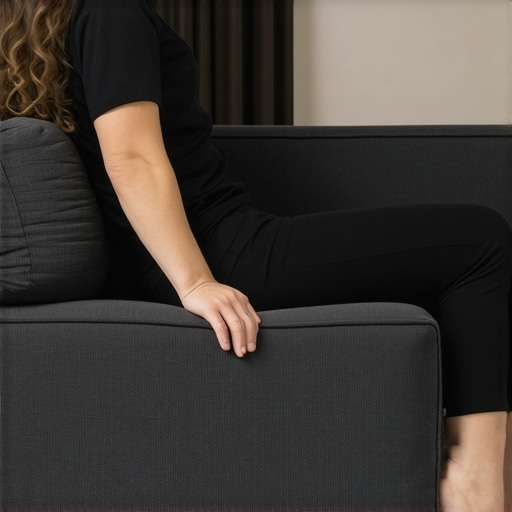
Why Your Knees Hold the Key to Back Relief
If your feet are dangling or your knees are tucked up to your chest, your lower back is taking a beating. You want your feet flat on the floor or on a stable surface. If the couch is too deep, your legs act like a lever, pulling your lower back into that dreaded ‘C’ shape. Use a footrest or a stack of books if the floor is too far away. This is the single best way to sit on a couch without slumping. I used to think putting my feet up on the coffee table was the ultimate way to relax, but I soon realized it was actually overstretching my sciatic nerve and keeping my lower back under constant tension.
Change Your View Every Twenty Minutes
Static loading is a quiet killer for spinal health. Your discs are like sponges; they need movement to circulate fluid and nutrients. Even with perfect posture, sitting still for two hours will cause mechanical fatigue. Every twenty minutes, stand up, reach for the ceiling, and reset your system. To truly enhance your mobility, you have to break the cycle of stagnation. You can also adjust your routine for daily spinal alignments by incorporating these small breaks into your evening routine. I started setting a silent vibrating alarm on my phone during Netflix marathons. It felt a bit obsessive at first, but not waking up with a ‘frozen’ spine made the habit worth its weight in gold.Let’s dig deeper into a nuance that even the most dedicated gym-goers often miss. We’ve all been told that a ‘strong core’ is the ultimate shield against back pain, but here is the contrarian truth: a core that is always ‘on’ is a core that is failing you. I see this constantly in my clinic—individuals with visible abdominals who suffer from chronic, deep aching. The mistake is confusing constant tension with actual stability. When you perpetually brace your midsection, you aren’t just protecting your spine; you are creating a pressurized cylinder that has nowhere to vent. This leads to increased intra-abdominal pressure and what we call ‘shear stress,’ which explains why your core strength isn’t stopping your back aches despite all those planks. In fact, if you’re always ‘sucking it in’ to look thinner, you are likely falling into the trap of why you should stop sucking in your stomach to look thinner. This habit locks the lower ribs and prevents the diaphragm from descending, forcing your neck and lower back to work overtime just to help you breathe. Dr. Stuart McGill, a world-renowned spine biomechanics expert, has highlighted in his research that true spinal health comes from ‘proximal stiffness’—a burst of stability when lifting heavy—not a 24/7 internal vacuum that prevents your joints from moving naturally. 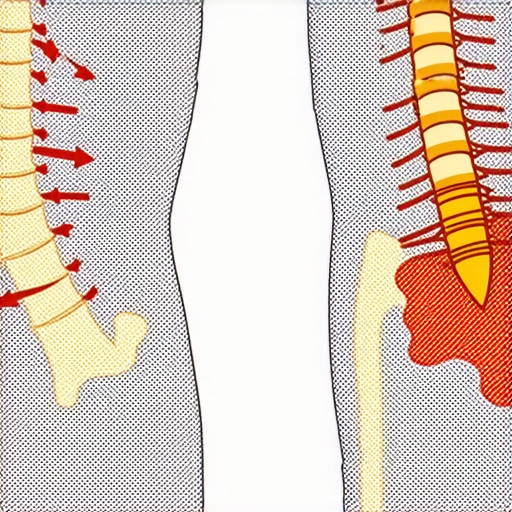
Why does your lower back scream after a ‘perfect’ pilates session?
It sounds counterintuitive, doesn’t it? You followed every instruction, tucked the pelvis, and kept the back flat. But that ‘flat back’ is often an advanced-level trap. Your spine has natural curves for a reason; they act like a mechanical spring to absorb shock. When you force your spine into a perfectly straight line during repetitive movement, you are essentially grinding your discs together rather than letting the muscles share the load. This is where mobility mastery shifts from ‘doing more’ to ‘doing less.’ Another hidden ‘oops’ factor is the obsession with the psoas muscle. Many people feel a ‘tight’ sensation in the front of their hips and immediately start aggressive lunges. However, understanding why stretching your psoas might actually be making your back hurt more is vital: if your spine is already unstable, that tight psoas is likely acting as a secondary stabilizer. By stretching it out without fixing the underlying issue, you’re pulling the pin on the only thing holding your lower back together. To truly fix this, you need to find the deep core connection that stops your spine from shear stress without creating unnecessary rigidity. Think of your spine like a high-performance suspension system; it needs to be firm under load but fluid during rest. True posture correction secrets involve allowing the spine to be dynamic rather than static. Have you ever fallen into this trap of over-bracing? Let me know in the comments.I’ve spent a fortune on fancy gear over the years, but the most effective tools in my arsenal actually cost less than a latte. For instance, I keep a tennis ball under my desk at all times. Why? Because your feet are the sensory foundation for your entire spine. When I feel that familiar tug in my lower back, I spend two minutes rolling the arch of my foot. This isn’t just a foot massage; it’s a neurological reset that relaxes the entire posterior chain. You can learn exactly how to use a tennis ball to release tension in your feet and back to see how this simple trick impacts your lumbar tension. I also stopped guessing my screen height. I realized my neck was constantly under shear because my monitor was an inch too low. Now, I strictly follow the 2-inch rule for your laptop stand to save your neck from strain. It sounds minor, but that extra height prevents the C7-T1 junction from bearing the weight of a bowling ball all day. 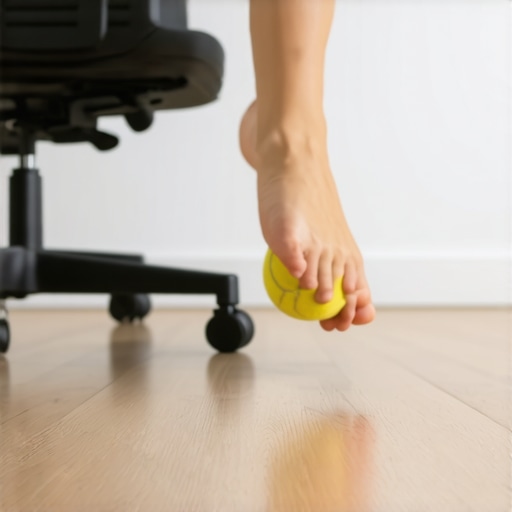
How can I stay consistent without feeling like a full-time patient?
The secret is ‘micro-dosing’ your mobility. I don’t set aside an hour for ‘posture time’ anymore. Instead, I use transitions—like waiting for a kettle to boil or a Zoom call to start—to perform the 30-second wall reset for hunchback posture. This consistency beats a weekly hour-long yoga class every single time. Dr. Kelly Starrett, a physical therapist and author of Becoming a Supple Leopard, emphasizes that it takes about two minutes of localized pressure to actually change the ‘viscoelastic’ properties of your tissues. If you aren’t hitting that two-minute threshold during your daily adjustments to alleviate back pain, you are just stretching the elastic part of the muscle, which will snap right back once you sit down. Looking ahead, I predict we are moving away from bulky braces toward ‘smart textiles.’ We are already seeing the development of EMG-integrated clothing that provides haptic feedback—a gentle buzz—the moment your lumbar curve starts to flatten. This will shift the burden from conscious effort to subconscious habit. Until that tech is in every t-shirt, you must adjust your routine for daily spinal alignments using the tools you have. I want you to try this: tomorrow morning, before you even check your email, spend two minutes on the floor with that tennis ball under your arches. Feel how it changes the way you stand. This is how you enhance your mobility for the long haul. If you’re struggling to find the right starting point, feel free to contact us for more personalized guidance.
The Hardest Lesson I Learned About Sitting and Stability
If there is one thing I wish I’d known before I bought ‘The Marshmallow,’ it’s that your spine craves stability, not just squishy padding. I spent years thinking I was lazy for having back pain, but the truth is, I was just fighting a furniture war I couldn’t win. First, remember that ‘strong’ doesn’t mean ‘stiff.’ Over-bracing your core while you relax actually traps tension in your lower back. Second, posture correction secrets aren’t about being rigid; they are about finding ways to let your bones carry the weight so your muscles don’t have to. Finally, small changes—like a two-minute foot roll—will do more for your long-term health than an occasional intense gym session.
The Only Tools You Actually Need in Your Living Room
I’ve tested dozens of gadgets, but my daily routine always comes back to these few essentials. I highly recommend picking up a copy of Back Mechanic by Dr. Stuart McGill; it’s the gold standard for understanding how to protect your discs. For physical tools, a simple tennis ball is unbeatable for a quick foot arch release to enhance your mobility without leaving your chair. If you’re looking for more advanced guidance, check out Becoming a Supple Leopard by Dr. Kelly Starrett—it changed how I view ‘viscoelastic’ tissue changes. These resources helped me master mobility when I was at my lowest point.
Moving Toward a Future Without Constant Stiffness
Recovery isn’t a straight line, and you don’t have to be a ‘perfect’ patient to see results. By making small daily adjustments to alleviate back pain, you are slowly teaching your nervous system that it’s safe to move again. Don’t let the fear of a ‘bad’ chair keep you from enjoying your life. Use these hacks, trust the process, and adjust your routine for daily spinal alignments that stick. You deserve to wake up on a Saturday morning feeling refreshed, not like you’ve been through a car wreck. Have you ever noticed your back pain flares up after a specific ‘comfy’ chair or couch? Let me know in the comments below!