

Last Tuesday, I found myself stuck. Literally. I had spent two hours sunk into the corner of my plush, oversized sectional, and when I finally tried to stand up for a glass of water, my lower back felt like it had been fused together with industrial-grade wood glue. It was a visceral, sharp reminder that my favorite sanctuary was actually a trap. We all do it. We sink in, our pelvis tilts back, and our spine turns into a giant, strained question mark. I used to think the answer was just buying more decorative pillows, but I was dead wrong. Today, I am going to share the exact method I use to enjoy my Netflix marathons without the ‘old man’ groan when the credits roll.
Stop Letting Your Sofa Sink Your Spine
I learned the hard way that most of us are unknowingly committed to the couch position that is quietly ruining your lumbar curve. My early mistake was thinking that ‘soft’ equaled ‘supportive.’ I would surround myself with feather cushions, essentially creating a nest that forced my neck forward and my lower back into a deep, unsupported C-shape. It felt great for ten minutes, but it was a disaster for my discs. You see, when you slump, you aren’t just relaxing your muscles; you are hanging on your ligaments. According to research cited by the Cornell University Ergonomics Web, sitting in a slumped position can increase the pressure on your spinal discs by up to 90% compared to standing. That is a staggering amount of weight for your lower back to carry while you are trying to ‘relax.’ By making simple adjustments to relieve back pain, I realized I could actually feel refreshed after a movie rather than needing a chiropractor on speed dial. Have you ever felt that terrifying ‘stuck’ sensation in your hips after sitting for just twenty minutes?
Can you actually be comfy and upright at the same time?
Many people believe that ‘proper posture’ means sitting like a soldier on a wooden stool, but that is a myth that keeps us in pain. Skeptics often tell me they cannot stay upright because it is too much work for their core. I get it. But the secret isn’t about muscle effort; it is about bone alignment. If you master the simple pelvic tilt that makes sitting for hours painless, the couch stops being a source of inflammation and starts being a place of actual recovery. We are going to fix the way you sit by focusing on one key pivot point that most people completely ignore.
Build a Foundation That Doesn’t Crumble
To stop the cycle of back pain, we have to treat the pelvis like the base of a high-end camera tripod. If the base is tilted, every joint above it has to overcompensate just to keep you upright. Most people sit on a couch by letting their hips slide forward, which effectively spills the ‘internal’ support of the spine out the back. To fix this, you must engage in a physical recalibration. Reach under your glutes and find the ischial tuberosities—those two hard ‘sit bones.’ Pull the fleshy part of your seat back so you are perched directly on top of them. This creates the simple pelvic tilt that makes sitting for hours painless by ensuring your weight is distributed through your bones rather than your soft tissues. I remember trying this while watching a three-hour documentary last month. At first, it felt slightly more active than my usual ‘melt,’ but for the first time in years, my legs didn’t have that tingling, heavy sensation when I finally stood up.
Find Your Sit Bones and Tilt Your Pelvis Forward
When you sit, imagine your pelvis is a bowl filled with water. In a standard couch slump, that bowl is tipping backward, and the water is pouring out behind you. This posture is the primary driver behind the psoas release that finally stops your deep lower back ache. By tilting the bowl slightly forward, you re-establish the natural curve of your lower back. This isn’t about being rigid; it is about finding the ‘sweet spot’ where your spine stacks naturally. If you feel your abdominal muscles working slightly, you are doing it right. This minor engagement prevents the ‘shear’ stress that occurs when your vertebrae slide forward against each other in a deep, soft cushion.
Bridge the Void with a Personalized Lumbar Roll
Most sofas are simply too deep for the human frame. This creates a ‘no-man’s-land’ between the back of the couch and your actual spine. I once spent eighty dollars on a fancy memory foam lumbar support pillow that was so thick it literally pushed me off the seat. It was a total waste. I eventually discovered that a simple fleece blanket, folded and rolled into a firm ‘log,’ worked ten times better. By placing this roll exactly at the small of your back, you provide a ‘kickstand’ for your lumbar spine. This is essentially the chair hack to keep your pelvis neutral while working adapted for your leisure time. When that gap is filled, your brain finally gives your paraspinal muscles permission to relax. 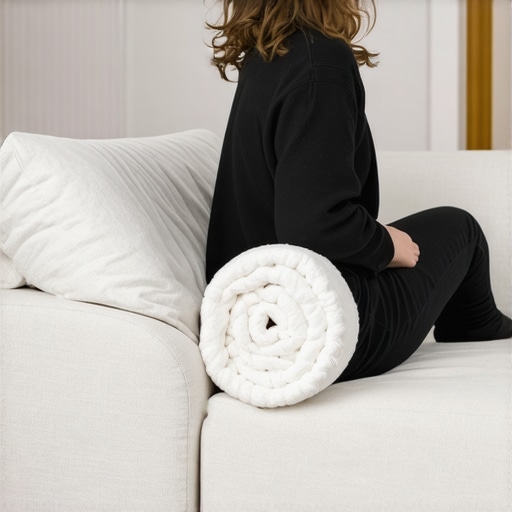
Elevate Your Screen to Protect Your Neck
Once your base is set, you have to address the ‘tech neck’ that happens during commercial breaks or phone scrolling. Your head weighs roughly twelve pounds, but for every inch it tilts forward, the effective weight on your neck doubles. If you are looking down at a laptop or tablet on the couch, you are inviting why your laptop screen height is killing your upper back to ruin your evening. Use a firm cushion on your lap to prop up your device or your arms. This brings the screen closer to eye level and prevents the ‘burning’ sensation between your shoulder blades. I used to think I needed a massage every week, but I actually just needed to stop looking at my lap. If you integrate the simple towel trick for stiff morning necks into your support routine, you will find that the stiffness simply stops accumulating in the first place. By unlocking better posture through simple adjustments, you transform your couch from a source of inflammation into a place of genuine recovery.Even when we think we are doing everything right, we often fall into the trap of ‘over-correcting.’ I see it all the time: people who have traded their couch slump for a rigid, military-style posture that is actually just as damaging. They are trying so hard to be perfect that they have forgotten how to be mobile. This leads to a massive misconception that ‘strength’ is the only thing standing between you and a pain-free life. In reality, a back that can’t move is just as vulnerable as a back that can’t stay upright.
Don’t Turn Your Core into a Suit of Armor
Most people believe that to protect the spine, you must keep your abs permanently flexed. I used to be a ‘gym-bro’ about this, thinking that a rock-hard core was my best defense. But if your midsection is always locked, your spine loses its ability to absorb shock. This rigidity is exactly why your core strength isn’t stopping your back aches. When you are too stiff, the force of every step you take travels straight into your discs rather than being distributed through your muscles and fascia. We need to focus on ‘bracing’ during heavy lifts, but ‘breathing’ during daily life. True stability is about the the secret to strengthening your deep core without sit-ups, which involves a dynamic coordination between your diaphragm and your pelvic floor, not just a six-pack.
Is your quest for a flat stomach ruining your spinal stability?
One of the most common mistakes I see—and one I definitely made for years—is ‘hollowing’ or sucking in the stomach to look thinner. This isn’t just an aesthetic habit; it’s a structural disaster. When you suck in your gut, you flatten your lumbar curve and put immense pressure on your internal organs and spinal nerves. A study published in the *Journal of Biomechanics* suggests that this ‘hollowing’ technique actually reduces spinal stability compared to a natural, relaxed brace. This is why you should stop sucking in your stomach to look thinner if you want to avoid chronic disc compression. By forcing the abdomen inward, you lose the ‘360-degree’ internal pressure that keeps your vertebrae properly spaced. 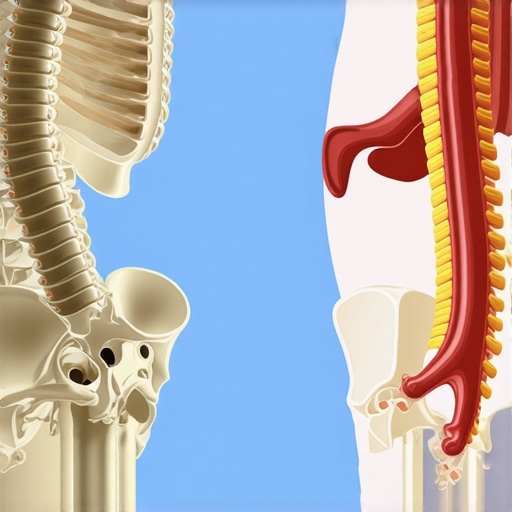
Avoid the Common Stretching Trap
We are told from childhood that if something feels tight, we should stretch it. This is a half-truth that leads to a lot of unnecessary injury. Sometimes, a muscle feels tight because it is actually over-stretched and weak, not short. For example, many people spend hours tugging at their hamstrings, but why stretching your hamstrings might be making your back pain worse is usually due to the fact that those muscles are already being pulled taut by a tilted pelvis. If you keep stretching a muscle that is already under tension, you are just inviting a strain. The same goes for the front of your hips. I’ve found that why stretching your psoas might actually be making your back hurt more is often because the psoas is trying to stabilize your spine in the absence of deep core support. If you ‘release’ it without building stability elsewhere, your back loses its primary internal guy-wire. Have you ever fallen into this trap of stretching a ‘tight’ spot only for it to feel worse the next day? Let me know in the comments.
Moving from the common mistakes of over-stretching, I had to find tools that actually worked to maintain my progress. For years, I thought I needed an expensive vibrating massage chair, but I eventually realized that the most effective tools are often the simplest. My daily kit now consists of a high-density lacrosse ball and a specific routine that prioritizes spinal hygiene. I don’t just roll aimlessly; I use the ball to pin down specific trigger points in my mid-back that my foam roller simply cannot reach. By learning the proper way to use a foam roller on your upper back, I’ve managed to keep my thoracic spine mobile even during high-stress work weeks. This isn’t about a quick fix; it’s about adjusting your routine for lasting relief through consistency rather than intensity.
Stop Guessing and Start Tracking Your Mobility
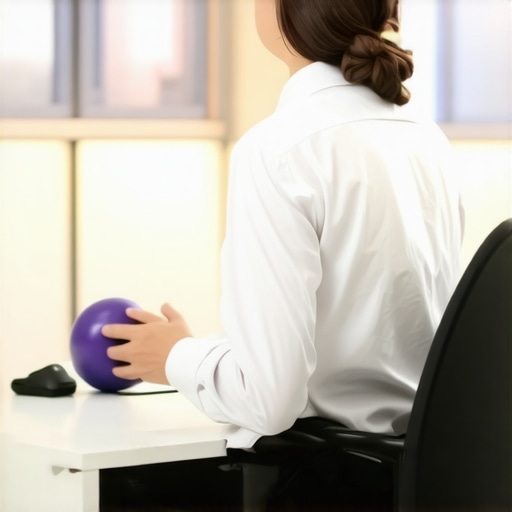
One of the biggest shifts in my journey was moving away from ‘feeling’ like I was aligned to actually verifying it. I started using a simple 60-second test every morning. I stand against a flat wall and check if my heels, glutes, shoulders, and head can all touch the surface simultaneously without my lower back arching excessively. If I can’t, I know I’ve spent too much time in a ‘folded’ position. This is a practical application of the principles taught by Dr. Stuart McGill, a world-renowned spine biomechanics expert, who emphasizes the ‘Big 3’ exercises—the bird-dog, the side-plank, and the modified curl-up—to build true endurance in the spinal stabilizers. I also keep a tennis ball in my travel bag because using a tennis ball to release tension in your feet and back is the easiest way to combat the stiffness of a long flight or car ride.
How do I maintain my spinal health over time?
The secret to maintenance isn’t a 90-minute yoga class once a week; it’s the five-minute blocks of movement you do throughout the day. I use a ‘movement snack’ approach. Every hour, I perform a standing desk reset. I don’t just stand up; I actively engage my glutes and pull my shoulder blades back to reverse the keyboard slouch. This is a core part of my strategies for moving without pain. If you wait until you are in pain to move, you are already playing catch-up. I recommend setting a silent haptic alarm on your watch every 45 minutes to remind you to check your pelvic tilt. By enhancing your mobility through expert tips like these, you stop the accumulation of micro-trauma that leads to those ‘mystery’ back flare-ups.
Smart Fabrics and AI are Coming for Your Slouch
Looking ahead, I predict we are going to see a massive shift toward wearable biofeedback. We are already seeing the first generation of ‘smart’ shirts that use tension sensors to vibrate when your shoulders roll forward. While I’m a fan of the ‘manual’ work we’ve discussed, having an external nudge to maintain better posture through simple adjustments will make these habits much easier for the average person to maintain. The future of spinal health isn’t in more surgeries; it’s in the real-time data that helps us understand exactly when and why we are slumping. If you want to jump ahead of the curve, I challenge you to try the ’90-90-90′ check today: Sit with your hips, knees, and ankles all at 90-degree angles and see how long you can maintain that without your lower back rounding into the chair.
We’ve covered a lot of ground, from the way you sit on your sofa to the hidden traps of over-stretching. But the real change happens when you stop seeing your back as something ‘broken’ and start seeing it as something that needs better communication. Here is the wisdom I wish I had at the beginning of my journey.
Hard Truths I Learned on the Road to a Resilient Spine
- Perfection is a trap. You don’t need a military-straight spine 24/7; you need the ability to move in and out of different positions without fear.
- Consistency beats intensity every time. Five minutes of daily spinal alignments for lasting relief is worth more than a two-hour gym session once a week.
- Your breath is a structural tool. Learning how to breathe into your lower back to release tension changed my life more than any fancy chair ever could. It creates internal pressure that supports you from the inside out.
The Daily Gear That Keeps Me Out of Pain
I don’t believe in expensive gadgets, but I do believe in tools that provide high-quality feedback. To stay mobile, I rely on a few simple items that have earned their place in my home. First, a high-density lacrosse ball for pinpointing knots—it is much more effective than a soft roller for deep tissue. Second, a simple firm towel that I use for the 30-second wall reset for hunchback posture every time I finish a long work call. Finally, I highly recommend the works of Dr. Stuart McGill; his ‘Big 3’ routine is the gold standard for building the kind of endurance that prevents injury. These simple exercises to relieve chronic back pain are the foundation of everything I do.
#IMAGE_PLACEHOLDER_E#
Start Rewriting Your Body’s Story Today
Your journey to better mobility doesn’t have to be overwhelming. It starts with a single pelvic tilt, a better-positioned laptop, or a simple movement snack between emails. By integrating these posture tips for 2025, you are giving your body the permission it needs to heal and thrive. Don’t wait for the pain to get ‘bad enough’ to take action. You deserve to live a life where you don’t have to think twice about sitting on the couch or picking up a grocery bag. Let’s make back pain a chapter of your past, not a recurring theme in your future. Have you ever noticed that your back feels stiffer after a specific activity, like driving or gardening? Let me know in the comments below!