

I’ll never forget the rainy Tuesday I tried to hop into my SUV like I was twenty years younger. I led with my right leg, twisted my torso, and—*snap*—a white-hot bolt of lightning shot from my tailbone to my shoulder blades. I spent the next twenty minutes leaning against the steering wheel, breathing through my teeth, and wondering how a simple car door became my greatest enemy. If you’ve ever felt that sharp twinge while trying to run errands, you know exactly the dread I’m talking about. We often focus on daily adjustments to alleviate back pain and improve posture, but we completely ignore the mechanics of how we actually get into the driver’s seat. Today, I’m sharing the “Butt-First” method that changed everything for me. We are going to fix your entry routine so you can finally stop worrying about why your tailbone aches after long car rides and how to fix it before you even pull out of the driveway.
Why Your Current Way of Getting in the Car is Total Torture
The mistake I made for years was “the lunge.” I’d throw one leg in, duck my head, and hope for the best. This creates a massive amount of shear stress on the L5-S1 disc because your spine is essentially a wet noodle being wrung out while supporting your body weight. I even thought why your core strength isn’t stopping your back aches was the primary problem, but no amount of planks can save a spine being twisted like a pretzel. When you lead with one leg, you force your pelvis to rotate independently of your shoulders. This is the exact moment when the hidden reason your middle back burns after driving begins to take root. According to research published in the journal Spine, axial rotation combined with flexion—exactly the posture we assume when climbing into a car—is a primary mechanism for disc injury. I had to learn the hard way that to master your mobility requires thinking about every transition, especially the ones we do five times a day.
Does a Specific Seating Technique Really Make a Difference?
I hear the skepticism already. “It’s just a car, surely I don’t need a tutorial for it?” I used to think the same thing until I realized that my clumsy entry was setting me up for failure for the rest of the day. If you don’t unlock better back health at the start of your journey, your body stays in a guarded, inflammatory state. Have you ever noticed that your back feels “locked” the moment you stand up after a drive? That’s likely because of the strain caused by your entry style. By changing my approach, I noticed I didn’t need as many daily spinal alignments for lasting relief just to feel human again. Have you ever felt a sharp pain just reaching for the seatbelt? If so, you’re not alone, and it’s time we talk about the solution.
The Master Strategy for Pain-Free Entry
Think of your spine like a stack of fragile dinner plates. If you twist the middle while putting weight on them, they’ll slide out of alignment. To avoid this, you need to treat your torso and hips as one solid unit. This is why you should always enhance your mobility through intentional movement patterns rather than relying on raw flexibility. By moving as a single block, you neutralize the rotational forces that typically pinch nerves or irritate discs during the transition from standing to sitting.
Turn Your Back to the Open Door
Instead of leading with one foot, walk up to your car door and turn around until your calves are touching the seat’s edge. You want to be facing away from the vehicle. This position ensures your pelvis is level and ready to descend vertically. I remember the first time I did this at a crowded grocery store. I felt a bit ridiculous standing there with my back to my SUV like I was about to sit on a throne, but for the first time in months, I didn’t feel that familiar “tugging” in my sacroiliac joint. It turns out that the specific way to sit that stops tailbone pressure starts before your glutes even touch the fabric.

The Controlled Descent
Lower yourself slowly using the door frame or the car’s handle for stability. This is where you engage the deep core connection that stops your spine from shear stress. You aren’t just dropping; you’re placing your weight. If you’ve ever wondered why your knees buckle when you stand up too fast or sit down too hard, it’s often due to a lack of eccentric control. By using your arms to bridge the gap, you take the load off your lower lumbar discs and prevent the jarring impact that causes spinal joints to lock up.
Swivel Your Entire Body Like a Unit
Once your glutes are firmly on the seat, do not—I repeat, do not—bring your legs in one at a time. Keep your knees and ankles glued together as if they were taped and pivot on your sit-bones. This “log roll” technique keeps your spine from twisting. It’s the same logic used when you adjust your sleeping position for neck herniations; keeping everything aligned prevents localized pressure points. When I finally mastered this, the sharp mid-back burning I used to get before even shifting into gear completely vanished. It felt like my spine was finally being protected by a suit of armor rather than being exposed to constant torque.
Check Your Alignment Before You Drive
Now that you’re in, don’t just reach for the wheel. Take five seconds to pursue unlocking better posture by checking your seat depth. Your knees should be slightly lower than your hips to maintain a neutral pelvic tilt. If your headrest is too far back, you’re inviting tension, so make sure to use the right way to adjust your headrest to prevent whiplash symptoms. This tiny habit loop prevents the “C-curve” slouch that makes the couch position that is quietly ruining your lumbar curve look like a minor issue by comparison.
Most posture experts will tell you to sit at a perfect 90-degree angle, but in my experience, that is one of the biggest myths in ergonomics. When you sit at a strict right angle, you are actually maximizing the load on your lumbar discs. According to the foundational research of Dr. Alf Nachemson on intradiscal pressure, the load on your lower back increases by nearly 40% when moving from a standing position to a 90-degree seated position. The nuance that most people miss is the sweet spot recline. A seatback angle of approximately 100 to 110 degrees allows the chair to actually support your weight, taking the sheer stress off your L5-S1. This is one of those posture correction secrets that transform back pain outcomes because it shifts your center of gravity backward and utilizes the car seat as a functional brace. 
Ditch the 90-Degree Sitting Rule
If you force yourself to sit perfectly upright, you aren’t just taxing your muscles; you are inviting joint fatigue. By reclining slightly, you allow the spinal extensor muscles to relax. This is why many find that chiropractic adjustments can clear brain fog after a long drive; you have finally stopped the constant fight between your muscles and gravity. When your spine is properly supported at an angle, the blood flow to the suboccipital muscles at the base of your skull improves, reducing the tension that often leads to that post-drive mental fatigue.
Stop Bracing Your Core Like a Statue
There is also a dangerous trap I see among the health-conscious: the hollow-body brace. Many drivers believe they should suck in their belly to engage the core while behind the wheel. However, you should stop sucking in your stomach to look thinner or feel protected. This constant tension creates high intra-abdominal pressure and locks your diaphragm. It is a primary reason why your mid-back feels stiff even after a massage. Your spine needs to move slightly with the car’s vibrations; if you are a rigid statue, your discs absorb 100% of the road shock. If you have ever had a stuck feeling in your mid-back, check your breathing—if your belly is not moving, your spine is suffering.
Is Your Lumbar Support Actually Harming Your Spine?
Another common mistake is over-cranking the lumbar support. While some support is vital, an aggressive lumbar bump can actually act like a fulcrum, pushing your lower vertebrae forward while your upper back slumps. This explains why your lumbar support might be making your pain worse by creating a sheer force rather than a supportive curve. The support should feel like a gentle nudge, not a localized pressure point. Have you ever fallen into this trap? Let me know in the comments.
Stop Guessing and Start Using a Dedicated Lumbar Roll
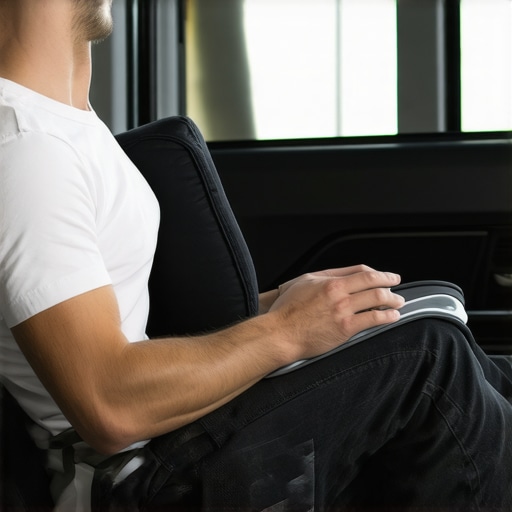
I spent hundreds on high-end office chairs before I realized the best thing for my car was a $25 McKenzie Lumbar Roll. Why this specific one? Because most “ergonomic” car seats are designed for a mythical average body, and if you don’t fit that mold, the built-in support is often in the wrong place. By using a portable roll, you can place it exactly at your L3-L4 junction. This is a game-changer for those who need to unlock better back health during long commutes. It forces your pelvis into a slight anterior tilt, which naturally maintains the lordotic curve without you having to constantly think about it. I personally carry mine in my backpack because I never know when I’ll be in a rideshare with a flat, back-destroying bench seat. Adding this layer of support helps you enhance your mobility by preventing the spinal stiffening that occurs after only 15 minutes of slouching.
How do I keep my spine healthy on 10-hour road trips?
Maintenance isn’t about one big fix; it’s about the “pumping” action of your discs. Dr. Stuart McGill, a world-renowned spine biomechanist and author of Back Mechanic, often highlights that sustained static postures lead to “tissue creep,” where the ligaments slowly stretch and lose their protective tension. When I’m on a long haul, I use the “15-minute micro-fidget.” Every quarter-hour, I subtly shift my weight from one sit-bone to the other. This prevents the cumulative trauma that makes your back feel like glass. If I start to feel that familiar tingle, I perform the nerve glide that calms sciatica pain in seconds at the next red light. This isn’t just about comfort; it’s about mastering your mobility so you don’t arrive at your destination feeling ten years older. You should also adjust your routine to include a 2-minute walk for every 2 hours of driving to re-lubricate the facet joints.
Active Seating Is the Next Frontier for Back Health
I predict that in the next few years, we’ll see “active” seats become standard in all vehicles, not just luxury models. We’re already seeing brands experiment with pneumatic bladders that inflate and deflate automatically to simulate walking motions while you drive. This will revolutionize how we approach daily adjustments to alleviate back pain and improve posture because the car itself will provide the necessary mechanical stimulation. Until then, you have to be your own ergonomic engineer. If you find your current seat is too soft, a firm wedge cushion can provide the stability needed for posture correction secrets that transform back pain outcomes. Tomorrow morning, I want you to try the “15-minute micro-fidget” during your drive. It sounds small, but preventing that static lock is the secret to a pain-free life on the road.
Spine Lessons I Learned the Hard Way
For a long time, I was convinced that if I just hit the gym harder, my driving pain would vanish. But the lightbulb moment came when I realized that stretching your psoas might actually be making your back hurt more if you are constantly irritating the disc during your morning commute. I also discovered that a morning routine to decompress your spine before coffee is far more effective than trying to ‘fix’ a back that has already been twisted into a car seat for an hour. Your spine has a memory, and it remembers the way you treat it in those small, five-second transitions.
Commuter Essentials That Actually Work
You don’t need a luxury vehicle to have an ergonomic experience. My personal toolkit starts with a firm lumbar roll—it’s non-negotiable for maintaining that natural curve. I also recommend looking into the chair hack to keep your pelvis neutral, which applies just as well to your car as it does to your office. For those who want to enhance flexibility and find mobility strategies for a more active life, I highly suggest keeping a tennis ball in your glove box for quick glute releases at rest stops. These tools are the bridge between ‘surviving’ your drive and actually enjoying the ride.
Change Your Entry, Change Your Day
Taking control of how you enter and exit your vehicle is one of the most powerful daily adjustments to alleviate back pain and improve posture you can make. It’s a small commitment that yields massive dividends in how you feel by 5:00 PM. When you stop fighting your car and start moving with your anatomy, you unlock posture correction secrets that transform back pain outcomes for the long haul. You deserve to arrive at your destination feeling energized, not broken. Have you ever noticed a sharp ‘catch’ in your back the moment you step out of your car? Let me know your experience in the comments below!