

I was sitting at a red light, humming along to the radio, when a sudden thump sent my coffee flying into the dashboard. It wasn’t a high-speed collision—just a distracted driver behind me forgetting to brake in stop-and-go traffic. But that tiny jolt felt like a lightning bolt through my spine. For weeks afterward, I dealt with a nagging ache that made turning my head to check my blind spot feel like a Herculean task. I realized then that my headrest—something I’d ignored for a decade—was sitting three inches too low. It didn’t actually rest my head; it acted like a pivot point for my neck to snap back over during the impact. My own laziness regarding my car setup was the reason I was suddenly figuring out if my neck was causing dizziness. Today, I’m going to show you how to stop that from happening to you.
Your Headrest is a Safety Device Not a Pillow
If you’re like I was, you probably think that piece of plastic and foam is there so you can nap during a lunch break or rest your skull while cruising. It’s not. It’s actually a Head Restraint, and when it’s misaligned, it’s a whiplash factory. I used to keep mine tilted back because I thought it looked sleeker, a mistake that cost me months of physical therapy and wasted money on massages that never quite reached the source of the problem. According to the Insurance Institute for Highway Safety (IIHS), neck injuries are the most common insurance claim, and a properly positioned head restraint can reduce the risk of neck injury by up to 40% in rear-end crashes. We’re going to fix your geometry today, ensuring your car becomes a fortress for your cervical spine rather than a liability. [image_placeholder_1] If you’ve ever felt that burning middle back pain after a long commute, your headrest height is likely the first domino to fall in a chain of poor postural habits.
Will a two-inch shift actually prevent a real injury?
I get the skepticism. It feels too simple to be effective. You might think you need a fancy new car or an expensive ergonomic cushion to stay safe. But the physics of whiplash are unforgiving: when your car is hit, the seat pushes your torso forward, while your head stays behind due to inertia. If there’s a gap or if the restraint is too low, your neck takes the full force of that whip-like motion. I spent years thinking my daily tension headaches were just a result of a busy life, only to find out my driving posture was the hidden culprit. Have you ever walked away from a small parking lot bump feeling fine, only to wake up the next morning feeling like your head weighs a hundred pounds? If so, you’ve already experienced the failure of a bad headrest setup. Let’s look at the specific steps to make sure your neck is locked in safely for your next drive.
The Perfect Height Starts at the Top of Your Head
The most common mistake I see is people treating the headrest like a neck pillow. If the top of the restraint is hitting the base of your skull, you’ve essentially created a pivot point for your head to snap over in an accident. You want the top of the headrest to be at least level with the top of your head. Think of it like a baseball glove catching a ball; you want the widest part of the restraint to catch the bulk of your skull’s weight. When I finally adjusted mine properly, I noticed that the 2-minute habit to fix your forward head posture became much easier to maintain because my car wasn’t forcing me into a slouch anymore. If the headrest is too low, it actually encourages that rounded-shoulder look we all try to avoid.
Align the Top Edge to Your Crown
I once rented a tiny hatchback in Seattle for a quick trip. In my rush, I ignored the seat settings. Twenty miles in, my neck felt like it was being squeezed in a vise. I pulled over at a rest stop, raised the headrest three inches so the top edge matched the top of my head, and the tension vanished within minutes. It felt like my spine finally had permission to relax. This simple height shift is as effective for your body as the 2-inch rule for your laptop stand to save your neck from strain; it eliminates the need for your postural muscles to work overtime just to keep your head upright. 
Close the Gap Between Your Skull and the Foam
Height is only half the battle. If there is a massive gap between the back of your head and the restraint, your head will still travel a dangerous distance before making contact during a rear-end collision. Ideally, the distance should be about two inches or less—roughly the width of two fingers. If you find yourself leaning forward to reach the steering wheel, you’re creating a “whiplash zone” behind you. I found that by closing this gap, I actually reduced the clicking in my jaw during long drives. There is a surprisingly hidden link between your jaw pain and your neck slump that people often overlook, and the car seat is usually the primary culprit.
The Fist Test for Instant Safety
Try this: sit in your normal driving position and try to fit your fist between your head and the headrest. If it fits easily, the gap is too large. You need to adjust the tilt of the headrest (if your car allows it) or slightly bring the seat back more upright. In my old SUV, I had to physically bend the mounting posts slightly to get the angle right because the factory setting was so aggressive. It was a messy, five-minute DIY fix, but it stopped the chronic headaches I’d had for three years. Proper alignment ensures that in a crash, your head and torso move together as a single unit rather than your neck acting as the whip.
Stop Lounging While You Drive
If your seat is reclined like a lawn chair, no amount of headrest adjustment will save you. A heavy recline makes it impossible for the headrest to do its job. I used to think a 45-degree angle was peak comfort until I realized it was the reason my lower back felt like lead every Friday afternoon. Much like the couch position that is quietly ruining your lumbar curve, a “cool” driving lean is a disaster for your spinal discs. Keep the seat back relatively upright—usually around 100 to 110 degrees—so your head naturally hovers near the restraint. Using the chair hack to keep your pelvis neutral while working can be applied here too; make sure your tailbone is tucked deep into the corner of the seat. If you feel a weird pressure in your lower back after doing this, you might need to check if your lumbar support might be making your pain worse by being too aggressive for your natural curve.
Everyone tells you to ‘sit up straight’ and ‘shoulders back,’ but honestly, that is one of the worst things you can do for long-term health if you are forcing it. We have been conditioned to think of posture as a static position—a snapshot of a soldier at attention. In reality, the best posture is your next posture. When you try to hold a ‘perfect’ position, you are essentially asking your muscles to perform a low-grade isometric hold for eight hours a day. No wonder you are exhausted by 3:00 PM. I used to be a stickler for the ‘chest out’ look until I realized it was the reason I couldn’t breathe deeply. This is a classic nuance: why you should stop sucking in your stomach to look thinner is a lesson in spinal pressure. Constant bracing prevents the natural micro-movements your vertebrae need to stay lubricated and happy.
Stop Yanking on Your Hamstrings to Fix Your Back
The most common trap I see people fall into is the ‘tightness’ illusion. Your lower back feels like a bridge cable, so you naturally reach for your toes. But if your pain is coming from neural tension or a disc that is already sensitized, why stretching your hamstrings might be making your back pain worse becomes a painful reality. Dr. Stuart McGill, a leading expert in spine biomechanics, explains that the ‘tightness’ you feel is often protective tension—your brain’s way of guarding an unstable segment. When you stretch that protection away, you are basically removing the safety net. Instead of aggressive stretching, focusing on master your mobility through controlled movement often yields much faster results without the risk of a flare-up.
Can you actually over-correct your lumbar curve into a new problem?
Yes, and it happens more often than you’d think. In an effort to avoid the ‘slouch,’ many people force an extreme arch in their lower back, known as anterior pelvic tilt. This crushes the facet joints at the back of your spine. I’ve seen patients who spent thousands on ergonomic chairs only to find that these posture correction secrets were being undermined by their own over-zealous ‘correction.’ If you feel a sharp, pinching sensation when you stand up tall, you are likely over-extending. The goal is a neutral spine, not a hyper-arched one. Have you ever fallen into this trap of trying to ‘force’ your posture and ending up more sore? Let me know in the comments.
The Secret is in the Pelvis Not the Shoulders
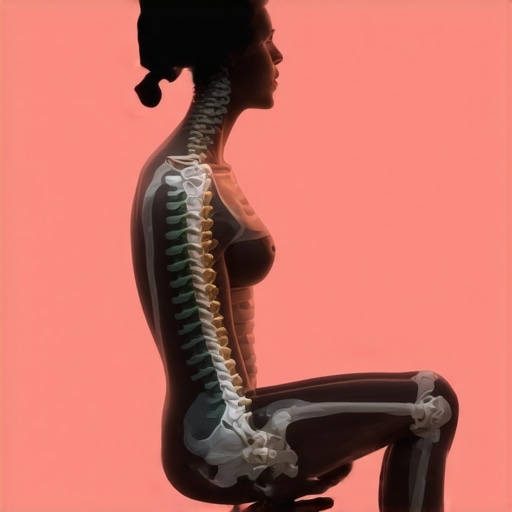
Most people try to fix their posture from the top down, but that is like trying to straighten a leaning tower by repainting the roof. Your shoulders are just passengers on the ship that is your ribcage, and your ribcage sits on your pelvis. If your pelvis is tilted, your head and shoulders have no choice but to compensate. By learning why your pelvis tilts forward and how to reset it fast, you address the root cause of the slouch. Once the foundation is level, your shoulders will naturally fall into place without you having to exert constant mental effort. This is the difference between fighting your body and working with it. Moving forward, we will look at how to maintain these adjustments even when life gets hectic.
Ditch the Fancy Seat Covers for a Simple Towel
I’ve tested dozens of ‘ergonomic’ car cushions that cost upwards of eighty dollars, and honestly, most of them are garbage. They are often too thick, pushing your entire body forward and away from the safety of the headrest. Instead, I use a medium-sized bath towel rolled into a firm cylinder. I place it exactly at the level of my belt line. This creates a physical reminder for my lumbar spine to stay in a neutral curve without the aggressive ‘poking’ feeling of many built-in lumbar supports. When you combine this with the simple pelvic tilt that makes sitting for hours painless, you effectively turn your car seat into a custom-molded orthopedic tool. This simple setup is how I finally addressed why your tailbone aches after long car rides and how to fix it, by removing the shear force on the sacrum.
How do I maintain my spinal alignment over long periods of time?
Consistency is the only thing that beats gravity. You can have the perfect setup, but if you sit for four hours straight, your tissues will eventually creep into a deformed state. I follow the ’30-minute reset’ rule. Every time my GPS tells me I have another half hour to go, I perform a quick series of shoulder blade squeezes and a chin tuck. Dr. Joan Vernikos, former director of NASA’s Life Sciences Division and author of Sitting Kills, Moving Heals, notes that the act of simply changing your posture against gravity is one of the most powerful signals you can give your body to stay healthy. This isn’t about a workout; it’s about adjust-your-routine-daily-spinal-alignments-for-lasting-relief. Integrating mobility-mastery-simple-exercises-to-relieve-chronic-back-pain during your rest stops will do more for your long-term comfort than any expensive chiropractor visit ever could if you are just returning to a bad setup afterward.
The Future of Driving Posture and Smart Seats
We are rapidly moving toward a world where your car will be smarter than your physical therapist. I predict that within the next five years, biometric sensors in the seat fabric will detect when your paraspinal muscles are fatiguing and automatically adjust the lumbar inflation or tilt the seat base by a fraction of a degree to shift the load. Until those ‘smart seats’ become standard, the burden of maintenance is on you.  I’ve found that using daily-adjustments-to-alleviate-back-pain-and-improve-posture while waiting at red lights—like a quick pelvic floor engagement or a ribcage expansion—keeps the blood flowing to the discs. My challenge for you: the next time you get in your car, don’t just drive. Take 30 seconds to perform the ‘fist test’ for your headrest and place a small support behind your lower back. That tiny shift is the difference between a minor bump and a life-changing whiplash injury.
Why My Car Used to Be a Pain Chamber
After my accident, I realized that my mirrors were actually my biggest enemy. I had adjusted my rearview mirror while I was slouching at the end of a long day. This meant that every time I drove thereafter, I had to slouch just to see the traffic behind me. Now, I set my mirrors only after I’ve done the ‘fist test’ and established my effective posture tips for 2025. If I can’t see out the back window, I know I’m slipping into a dangerous habit. Another realization was that whiplash isn’t just about speed; it’s about the ‘gap.’ I used to think a little space was comfortable, but that space is exactly where the injury happens. By using posture correction secrets that transform back pain outcomes, I learned to embrace the support of the seat rather than fighting against it. #IMAGE_PLACEHOLDER_FINAL#
The Only Tools I Keep in My Glovebox for Spinal Health
I don’t believe in over-complicating things with expensive gadgets. My first recommendation is Back Mechanic by Dr. Stuart McGill. It’s the definitive guide to understanding why your back hurts and how to stop it through biomechanics. I also keep a firm, medium-sized towel in the backseat. It’s more versatile than any store-bought lumbar pillow and allows me to master your mobility even during a traffic jam. Finally, I highly recommend Sitting Kills, Moving Heals by Dr. Joan Vernikos for anyone who spends more than an hour a day in a car; it changed how I view the ’30-minute reset’ and the importance of gravity on our discs.
Take Back Control of Your Daily Drive
You don’t have to accept a stiff neck or a burning back as the unavoidable price of a commute. By making these small shifts today, you are essentially buying insurance for your future self. Achieving lasting spinal alignment is a journey of small, consistent choices, not a one-time fix. When you adjust-your-routine-daily-spinal-alignments-for-lasting-relief, the car stops being a source of stress and starts being a place where you can actually relax safely. Have you tried the ‘fist test’ in your car yet? Let me know in the comments how much of a gap you discovered!