

I was staring at my monitor last Tuesday when I realized I’d become a human question mark. My shoulders were glued to my ears. My neck felt like a rusted hinge. I tried to do that thing we all do—I yanked my head to the side until it popped, thinking that would fix it. Spoiler alert: it only made the stiffness worse. I was frustrated, cranky, and honestly, a bit worried that this was just my new normal at forty. But then I remembered a simple drill a physical therapist friend showed me years ago. I stood up, found a flat patch of wall, and thirty seconds later? I could actually breathe again. [image_placeholder]
Stop Fighting Your Desk and Start Moving Again
I truly believe we live in a world designed to pull us forward. Your phone, your laptop, and even your car seat—it is all a conspiracy against your upper back. Most people think they need a hour-long gym session or an expensive massage to fix the burn. They don’t. What they need is to reverse the ‘hunch.’ I made a massive mistake early on by thinking I could just ‘stretch’ my way out of it without changing my patterns, but understanding why your shoulders hike up is the first step toward a real fix. It is about waking up the muscles that have gone to sleep. According to research published in the journal Surgical Technology International, leaning your head forward at a 60-degree angle to look at a phone can put up to 60 pounds of pressure on your cervical spine. That is like carrying an eight-year-old child on your neck all day! No wonder your traps are screaming.
Does a thirty-second move actually fix years of slouching?
It sounds too simple. I get it. I used to be the guy who thought if a movement didn’t involve heavy weights and a lot of sweat, it wasn’t doing anything. I was wrong. The wall slide isn’t about building bulk; it’s about neurological re-education. It teaches your brain where your shoulders are actually supposed to live. It is the ultimate move that reverses a day of phone-hunching. By incorporating simple adjustments for back pain, you finally stop the cycle of chronic tension and start feeling like yourself again. Have you ever felt like your shoulders were literally crawling up toward your jaw by mid-afternoon? Tell me in the comments if you’ve been struggling with that ‘stuck’ feeling lately.
Find a Flat Wall and Reset Your Entire Spine
To get results, you have to stop thinking of your posture as a static pose and start treating it like a moving gear system. The most effective way to do this is by performing the 30-second wall reset for hunchback posture. I remember the first time I tried this properly; I was waiting at an airport gate after a cramped six-hour flight. I found a concrete pillar, leaned back, and followed the steps. The ‘crunch’ I felt in my mid-back was so audible that a woman nearby actually asked if I needed a doctor. But immediately after, I felt like I had grown two inches. That ‘stuck’ sensation simply vanished because I finally gave my spine the feedback it was craving. 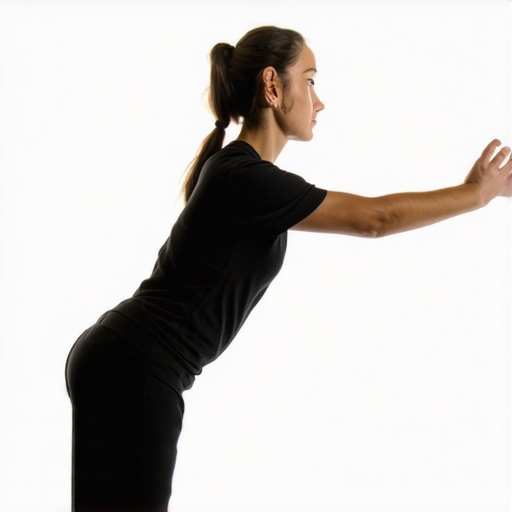
How to Execute the Wall Slide Without Cheating
Stand with your back against a flat wall. Your heels, butt, upper back, and the back of your head should all make contact. This is your baseline. Most people realize here just how much they have been leaning forward. Now, bring your arms up so your elbows and the backs of your hands are also touching the wall, forming a ‘W’ shape. Slowly slide your hands upward toward the ceiling, trying to keep everything—especially those elbows—glued to the wall. If your ribs start to flare out or your lower back arches away from the surface, you have reached your limit. Stop there, hold for three seconds, and slide back down. This isn’t just a stretch; it is a way to how to fix a stuck feeling in your mid-back by forcing your dormant postural muscles to wake up and do their job.
Stop the Burn Before Your Mouse Hand Goes Numb
We often ignore the warning shots our bodies fire until they become full-blown sirens. If you’ve ever wondered why your upper back burns after using a mouse for 2 hours, the answer usually lies in your ‘reaching’ habit. When you reach forward for your mouse, your shoulder blade drifts away from your spine, overstretching the muscles in between. Think of your shoulder blade like a boat anchor; if the anchor isn’t set, the boat—your arm—drifts into choppy waters. To reset the anchor, perform the shoulder blade squeeze that fixes mid-back knots instantly. Imagine trying to pinch a pencil between your blades. Hold it for five seconds, release, and repeat ten times. This brings the ‘anchor’ back to the dock.
The 2-Inch Rule for Your Workstation
Small geometric shifts at your desk pay massive dividends by five o’clock. You need to implement the 2-inch rule for your laptop stand to save your neck from strain. Most people have their screens far too low, which forces the chin to drop. By raising the top of your monitor just two inches above your eye level, you change the leverage point of your skull. This prevents the heavy ‘forward head’ shift that turns your neck muscles into strained guitar strings. Also, check your breathing. Many of us hold our breath or ‘brace’ our core to look thinner, but why you should stop sucking in your stomach to look thinner is a lesson in spinal pressure. When you suck in your gut, you force your breath into your upper chest, which makes your neck muscles work ten times harder than they should. Breathe into your belly to let your neck rest.
The biggest trap most of us fall into is thinking that a strong core is the ultimate shield against injury. We’ve been told for decades that if our ‘abs’ are strong, our back is safe. But I’ve seen powerlifters with six-packs who can’t sit for twenty minutes without a searing ache. The nuance they missed—and the one you might be missing too—is that why your core strength isnt stopping your back aches often comes down to timing, not power. Your deep stabilizers are like a dimmable light switch, not a simple on-off toggle. If you are constantly ‘bracing’ or sucking in your stomach, you are actually creating intra-abdominal pressure that can irritate your discs rather than protect them.
The Stretching Trap That Makes Back Pain Worse
Here is a contrarian view that usually gets some pushback: you probably need to stop stretching your hamstrings. When your lower back feels tight, the instinctual move is to reach for your toes. However, if your pain is coming from a disc issue or neural tension, that long, sustained pull is like tugging on a frayed rope. In many cases, why stretching your hamstrings might be making your back pain worse is because you are actually overstretching the sciatic nerve, not the muscle. This leads to a protective ‘locking’ mechanism where your brain keeps the muscles tight to prevent you from doing more damage. Instead of mindless stretching, focus on top mobility strategies for active living that prioritize joint health over muscle length.
Can you actually be ‘too flexible’ for your own spinal health?
It sounds like a paradox, but hypermobility can be just as dangerous as stiffness. According to research by Dr. Stuart McGill, a leading expert in spine biomechanics, the spine requires ‘stiffness’ for stability. If you are constantly ‘adjusting’ yourself or seeking out extreme ranges of motion without the muscle control to support it, you are essentially creating micro-instability in your vertebrae. This is why some people feel worse after a yoga class or an aggressive stretching session. You don’t just need to move; you need simple exercises to relieve chronic back pain that build control within the ranges you already have. Have you ever fallen into the trap of ‘over-stretching’ a sore spot only to have it feel tighter the next day? Let me know in the comments.
The Error of Relying on Passive Adjustments
The ‘Oops’ factor often happens when we treat our bodies like cars that just need a quick ‘fix’ from a professional. I love a good adjustment, and why you feel taller and lighter after a professional adjustment is due to the immediate neurological reset it provides. But the mistake is failing to ‘save’ that progress with movement. If you get adjusted and then immediately go back to the same slumped posture that caused the misalignment, you’re just pouring water into a leaky bucket. You must adjust your routine with daily spinal alignments at home to make those professional gains permanent. Real expertise isn’t about finding the one ‘magic’ crack; it’s about the boring, 30-second habits that keep your spine in place when no one is watching.
I am incredibly picky about gear because most ‘ergonomic’ products are just overpriced plastic with a marketing budget. But after years of trial and error, I have found that the best tools are often the simplest and most portable. Take the humble lumbar roll, for instance. I never drive more than twenty minutes without one now because implementing the chair hack to keep your pelvis neutral is nearly impossible to maintain in a standard, concave car seat. By placing a small, firm cushion or even a rolled-up towel just above my belt line, I force my lumbar spine into its natural inward curve. It is a low-tech solution that prevents that dreaded ‘car back’ ache before it even starts.
How do I maintain my spinal health over time?
Consistency beats intensity every single time. You do not need a grueling hour-long routine; you need a series of daily adjustments to alleviate back pain that become as automatic as brushing your teeth. I predict that over the next few years, we are going to see a massive shift toward wearable biofeedback—think of it like a smart watch but for your vertebrae—that vibrates when you have been slumping for more than five minutes. Until that tech becomes mainstream, we have to be our own sensors. You should aim to unlock better back health with effective posture tips for 2025 by performing a quick ‘mental scan’ of your body every time you finish a task or hang up the phone.
The Secret Weapon in My Gym Bag
If you really want to scale your results and move beyond basic stretches, you need to get comfortable with a lacrosse ball. A study published in the Journal of Bodywork and Movement Therapies found that self-myofascial release can significantly improve joint range of motion without decreasing muscle force production. I use a firm ball to pin down those nasty knots in my glutes or the ‘hot spots’ between my shoulder blades. It is cheap, it is portable, and it is far more effective than most expensive massage guns at getting into the deep tissue. This is one of those posture correction secrets that transform back pain outcomes because it addresses the physical restrictions that keep you pulled out of alignment.

Master the Basics Before Buying the Gimmicks
Do not go out and buy a thousand-dollar chair until you have actually tried expert tips for easier movement in 2025 like frequent position switching. Most of the time, the ‘burn’ isn’t because of your furniture; it is because of your lack of movement. If you are a heavy traveler, prioritize the best stretching routine for frequent travelers to counteract the compression of airline seats. My advanced tip for you today is to try ‘nerve flossing’ for your upper body. Instead of a long, static stretch, gently move your wrist and neck in opposing directions to slide your nerves through their pathways. It is a game-changer for that buzzing or tingling feeling that traditional stretching simply cannot touch. Try it for just two minutes tonight—your nervous system will feel the difference immediately.
The Realizations That Changed Everything for My Spine
Looking back at my years of struggling with stiffness, I’ve realized that the biggest breakthroughs didn’t come from a fancy gadget or an expensive weekend seminar. They came from understanding posture correction secrets that transform back pain outcomes—most of which are completely free. First, I learned that pain isn’t the enemy; it is a signal. When you feel that neck crunch when you look over your shoulder, it’s just your body asking for a change in position. Second, I stopped looking for a one-time ‘fix.’ Real relief comes when you adjust your routine with daily spinal alignments rather than waiting for a crisis to strike. Finally, I accepted that my desk was my gym; every hour spent sitting is an opportunity to practice simple adjustments to relieve back pain rather than letting gravity win.
The Gear That Actually Earned a Spot in My Office
[image_placeholder]
I’ve wasted plenty of money on ergonomic fads, but a few items have become non-negotiable for my daily comfort and focus. I always keep a high-density lacrosse ball in my drawer for mobility mastery—it’s the most efficient way to pinpoint those deep knots that a foam roller simply can’t reach. I also recommend adding a firm footrest to your setup to save your lower back at work by keeping your hips in a neutral, relaxed position. Lastly, I suggest looking into Dr. Stuart McGill’s work on spine mechanics; it completely reframed how I approach top mobility strategies for active living. These tools don’t just feel good; they provide the structural feedback your body needs to thrive in a digital world.
Your Next Chapter of Movement Starts Now
You don’t have to be ‘the person with the bad back’ for the rest of your life. By taking these small steps—the wall slides, the belly breathing, and the geometric desk adjustments—you are sending a clear message to your nervous system that you are back in charge. It’s time to unlock better back health with effective posture tips for 2025 and move into the future with confidence and strength. I promise you, the view is much better when you’re standing tall and breathing deep. Which one of these micro-adjustments are you going to try at your desk first today? Let me know in the comments below!