
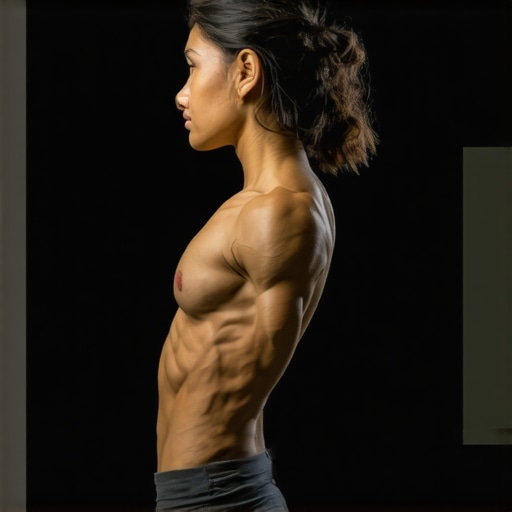
I was sitting at my kitchen table, nursing a lukewarm coffee, when I tried to take a deep breath and felt that familiar, sharp ‘catch’ right under my left shoulder blade. It wasn’t just a muscle ache; it felt like a tiny iron clamp had attached itself to my rib cage. I spent years thinking my spine was the primary problem, constantly wondering why your spine pops when you take a deep breath without providing any real relief. I even tried those aggressive self-cracking moves, but let me tell you, that is a trap that leads to more stiffness. Today, I am showing you the exact lat stretch that stopped that ‘stuck’ sensation for me, so you can finally expand your lungs without that annoying pinch.
Stop Blaming Your Spine for Rib Tightness
Most of us assume that if the mid-back feels jammed, the bones are the only things to blame. I made that mistake for a decade. I would focus entirely on how to fix a stuck feeling in your mid-back by twisting and popping, only to have the tension return twenty minutes later. The reality? Your latissimus dorsi—those massive ‘wing’ muscles—actually attach to your lower ribs and your spine. When they get tight from hours of slouching, they act like a straightjacket. Research published in the Journal of Physical Therapy Science indicates that restricted rib cage expansion is directly linked to decreased pulmonary function, meaning those tight muscles are literally stealing your breath. If you have ever noticed why your ribs feel tender near your spine, it is often those lats pulling everything out of alignment.
Is a Simple Stretch Actually Worth the Hype?
You might be skeptical. I was too. I thought I needed a professional adjustment every week just to function. But once I learned how to breathe into your lower back to release tension while simultaneously pinning the lat muscle in a deep stretch, the ‘stuck’ feeling vanished. Have you ever felt like you just could not get a full breath because of a stubborn spot in your back? Tell me I am not the only one who has tried to ‘elbow’ a doorframe just to get some relief! It is time to stop the guesswork and target the muscle that is actually causing the lockdown.
Turn Any Doorframe Into Your Best Mobility Tool
To stop that iron-clamp sensation, you need to understand that your lat muscle is like a piece of heavy-duty industrial plastic wrap. When it is tight, it doesn’t just sit there; it compresses your entire rib cage. To fix this, you don’t need a gym full of equipment. Find a sturdy doorframe or the edge of a wall. This is where you will create the leverage needed to pull those ribs apart. Most people fail here because they just ‘lean’ without intent. You are not just leaning; you are creating a mechanical anchor that allows your fascia to actually let go.
Anchor Your Arm to Create a Proper Lever
Reach your left arm up and grab the inside of the doorframe, well above your head. Now, here is the secret: do not just hold on. Step your left foot behind your right foot, crossing your legs. This creates a long line of tension from your pinky finger all the way down to your hip. I remember the first time I did this correctly. I was in a cramped breakroom at work, feeling like my upper back was made of concrete. I grabbed the doorframe, crossed my legs, and felt a stretch that actually reached the ‘hidden’ parts of my ribs. By unlocking better posture through simple adjustments like this, you allow the muscles to stop fighting your skeleton. 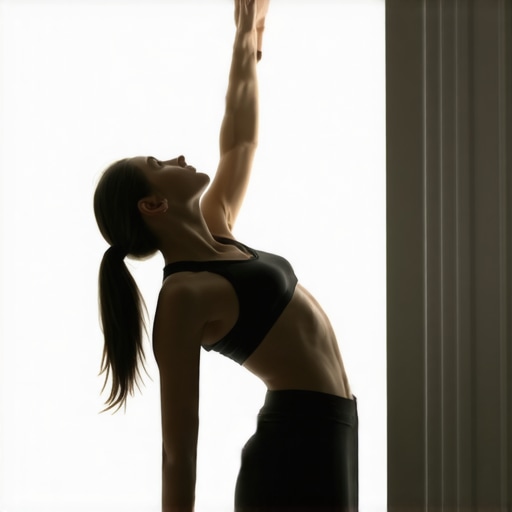
Breathe Into Your Back to Create Internal Pressure
Once you are in that arched position, looking like a human banana, do not just hang there. This is where the magic happens. You need to use your lungs as an internal balloon to push against the tight muscles from the inside out. Inhale deeply, specifically trying to send the air into the side of your ribs that is being stretched. This technique is much more effective than blindly using a massage tool. While some people prefer the proper way to use a foam roller on your upper back, that only addresses the surface. Breathing into the stretch targets the intercostal muscles between your ribs. When I first tried this ‘internal expansion,’ I felt a soft, thudding shift in my mid-back. It wasn’t a crack; it was the sensation of my ribs finally having room to move.
The Lean and Rotate Move
To finish the release, slowly rotate your chest toward the floor while keeping your grip firm on the doorframe. This targets the lower fibers of the lats and the serratus anterior—the ‘finger-like’ muscles on your side that often get ignored. If you have been searching for posture correction secrets that transform back pain outcomes, this rotation is the missing link. It forces the muscle to lengthen in a three-dimensional plane. Think of it as wringing out a wet towel. You are wringing the tension out of your side. Keep the movement slow and controlled. If you feel a sharp pinch, back off slightly. The goal is a deep, ‘good’ ache, not a stabbing pain. You are essentially teaching your nervous system that it is safe to let those ribs expand again. Combining this with the ability to how to breathe into your lower back to release tension ensures that the relief actually sticks rather than disappearing the moment you sit back down at your desk.But here is where things get controversial in the world of mobility. We have been told for years to ‘brace’ our core or ‘pull the belly button to the spine’ to protect our backs. In my experience, this is the fastest way to stay stiff. When you constantly ‘hollow’ your abdomen, you are actually inhibiting your diaphragm and increasing the pressure on your discs. Research from the Journal of Biomechanics shows that reflexive, natural core stabilization is far superior to conscious ‘sucking in’ for protecting the spine. This is exactly why you should stop sucking in your stomach to look thinner; you are essentially trading a flat stomach for a compressed spine. If you have ever wondered why your core strength isnt stopping your back aches, it is likely because you are over-bracing the superficial muscles while the deep stabilizers are off-duty.
Stop Sucking Your Stomach In
This constant tension prevents the very rib expansion we just worked on in that doorframe stretch. To really enhance your mobility with expert tips for easier movement in 2025, you have to let your belly move when you breathe. This allows the intra-abdominal pressure to support your spine from the front, rather than relying on your back muscles to do all the heavy lifting. 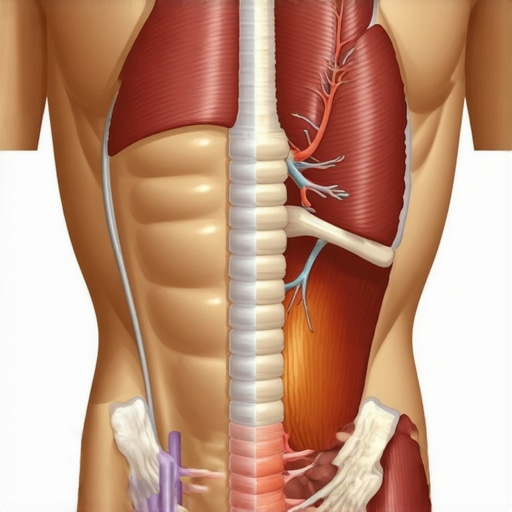
Why Does the Tension Return Even After a Perfect Adjustment?
Many of my readers ask why they feel great for an hour after a session but then the ‘pinch’ returns by dinner. Often, it is because the brain is still stuck in a protective ‘guarding’ loop. You might even find that why you feel wobbly after your first adjustment is actually a sign of your nervous system trying to find its new center. If you do not reinforce the new movement with the specific breathwork we discussed, your brain will pull those ribs right back into that ‘stuck’ position because it feels ‘safe’ there.
The Hamstring Trap That Actually Tightens Your Back
Here is the ‘oops’ factor I see most often: people trying to stretch their way out of lower back tightness by cranking on their hamstrings. It feels like it should help, but why stretching your hamstrings might be making your back pain worse-4 is actually a common phenomenon related to neural tension. Often, what feels like ‘tight’ hamstrings is actually your nerves being pulled like a guitar string from your spine. Aggressive stretching just irritates the nerve further, causing your back muscles to lock down even tighter to protect it. Instead of forcing length, focus on posture correction secrets that transform back pain outcomes by addressing the pelvic position first. Have you ever fallen into the trap of stretching a ‘tight’ spot only to have it feel tighter the next day? Let me know in the comments—I have been there too, and it is a frustrating cycle to break.The hardest part isn’t getting that first rib release; it’s making sure you don’t wake up tomorrow feeling like a rusted gate again. I used to think I needed to be a ‘mobility athlete’ spending ninety minutes a day on a mat, but that is a recipe for burnout. The key to daily spinal alignments for lasting relief isn’t the duration of your session; it’s the frequency of your movement. If you spend eight hours compressed at a desk, one ten-minute stretch won’t win the war. You have to interject. Dr. Stuart McGill, a world-renowned biomechanics expert at the University of Waterloo, emphasizes the concept of ‘spinal capacity’—essentially, you have a metabolic budget for how much load you can take before things start to hurt. By understanding why your spine needs movement every 30 minutes, you stop overdrawing that budget and causing chronic inflammation.
Grab These Two Cheap Tools Instead of a Fancy Massage Chair
You do not need a $3,000 chair to fix your back. I personally swear by a standard tennis ball and a yoga block. Most people use a foam roller, but it is often too ‘blunt’ for specific rib issues where the muscle is tucked deep under the bone. Learning how to use a tennis ball to release tension in your feet and back allows you to pin-point the exact spots where your lats or rhomboids are gluing your ribs together. Place the ball between your shoulder blade and your spine, lean against a wall, and breathe into that pressure. If you are struggling with neck tension alongside this, check out the monitor height hack for preventing c7-t1 nerve pressure. This simple change in your physical environment does more for your long-term health than any expensive gadget ever will. #IMAGE_PLACE_HOLDER_D#
How do I maintain my mobility gains over the long haul?
The secret is ‘micro-dosing’ movement. I keep a timer on my laptop that forces me to stand every half hour. During that break, I do one single lat stretch or a few simple exercises to relieve chronic back pain. This keeps the fascia hydrated. Think of your connective tissue like a sponge; if it stays squeezed dry and compressed for hours, it gets brittle and prone to tearing. If you keep it moving, it stays supple. I have found that even the 30-second wall slide for instant shoulder relief can reset my posture enough to finish the workday without that burning sensation between my blades.
The Future of Your Spine is Probably Digital
Looking ahead to 2025 and beyond, we are going to see a massive shift toward wearable biofeedback. I am already seeing apps that use your webcam to analyze your slouching in real-time. This is the ultimate way to enhance your mobility with expert tips for easier movement in 2025. Instead of guessing if you are standing straight, a haptic buzz on your wrist will tell you exactly when your lats have stopped supporting your ribs. We are moving away from ‘fixing’ pain and toward ‘preventing’ the mechanical breakdown before it starts. My challenge to you: next time you feel that ‘catch’ in your breath, don’t reach for the ibuprofen. Instead, find a doorframe and try the ‘Human Banana’ stretch I described earlier. If you do it every time you get up for water, you will be amazed at how much lighter you feel by Friday.
Hard Truths I Learned About My Stuck Ribs
After years of trial and error, I realized that a single stretch is just a band-aid if your daily habits are working against you. The most profound shift happened when I stopped looking for a magic click and started focusing on how to unlock better back health with effective posture tips for 2025. I learned that pain often moves around; what starts in your lats can eventually show up as a tension headache if ignored. Another big realization was that strong muscles can still be stiff muscles. You can have a six-pack but still have a back that feels like it is made of dry wood if you do not master your mobility with the right strategies for moving without pain. Finally, I had to accept that my body does not need to be fixed as much as it needs to be listened to. If your ribs feel tight, they are usually screaming for a change in position, not just a harder stretch.
Gear That Actually Earned a Permanent Spot in My Routine
I have wasted plenty of money on posture gimmicks, but a few simple things actually work. First, the humble tennis ball. Once you learn how to use a tennis ball to release tension in your feet and back, you will never go back to those expensive vibrating rollers. It is the perfect size to get between those stubborn ribs. Second, if you work from home, look at your screen. Applying the 2-inch rule for your laptop stand will save your upper back more than any weekly massage ever could. Lastly, if you use a standing desk, make sure you are not just trading back pain for foot pain. Following the correct way to use a standing desk without hurting your feet ensures you actually stay mobile throughout the day rather than just leaning on your joints.
Taking Your First Real Breath in Years
You do not have to live with that iron-clamp sensation around your ribs forever. By integrating small movements and daily spinal alignments for lasting relief, you are slowly teaching your nervous system that it is safe to let go of that protective guarding. It is a journey of small wins. Every time you use a doorframe to stretch or breathe into your back, you are investing in a future where movement feels like a gift rather than a chore. Which part of your back usually feels the tightest after a long day of sitting—the area between your shoulder blades or your lower ribs? Let me know below!