
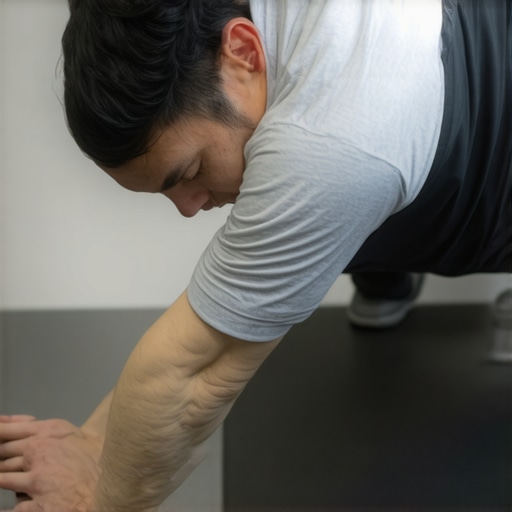
I remember lying on my living room rug three years ago, sweating through a set of fifty crunches. I wanted that iron-clad core we all see in fitness magazines. But by rep thirty, it wasn’t my abs burning—it was my lower back. It felt like a hot poker was pressing directly into my lumbar spine. I pushed through it, grit my teeth, and finished the set because I thought that’s what no pain, no gain meant. Boy, was I wrong. I ended up needing a week of ice packs just to stand up straight. That was my wake-up call. I realized that my quest for a flat stomach was actually wrecking the very foundation of my mobility.
Your Back Isn’t Weak—You’re Just Using the Wrong Muscles
Most of us grew up believing that the crunch was the gold standard for core fitness. I certainly did. I spent years forcing my spine to flex over and over again, wondering why I still felt like a creaky floorboard every time I got out of bed. The truth is, crunches often turn into a high-stakes tug-of-war between your abdominal muscles and your hip flexors. When your abs fatigue or fail to engage properly, your psoas takes over. It yanks on your lower vertebrae like a frantic bell-ringer. If you’ve ever wondered why your core strength isn’t stopping your back aches, you’re likely experiencing this muscle imbalance. My biggest mistake early on was assuming that if it hurt, I just needed to do more. In reality, I was just reinforcing a bad pattern that was pulling my spine out of alignment.
Are Crunches Actually Doing More Harm Than Good?
It’s a valid fear to have. If every workout ends with a mandatory visit to the heating pad, you naturally start to dread the gym. You might even start to think your back is permanently broken. It’s not. Research from institutions like Harvard Health indicates that traditional crunches can exert over 3,300 newtons of force on the spine during a single repetition. That is a massive amount of stress for a lumbar region that’s already taxed by sitting at a desk all day. You might find that the secret to strengthening your deep core without sit-ups is the missing piece to your puzzle. We’re going to fix this today by looking at how you move, not just how much you sweat. We are going to move away from those spine-crushers and into movements that actually protect your long-term health. Whether it’s learning the bird-dog move that every back pain sufferer needs or finally figuring out how to how to breathe into your lower back to release tension, the goal is movement that feels like a relief, not a chore. Have you ever had to cut a workout short because your back felt like it was about to snap? I want to hear about it, because I’ve been in that exact same spot, and there is a better way forward.
Turn Your Core Into a Protective Shield
The biggest mistake I ever made—and I see people making it every single day at the gym—is treating the core like a decorative piece of armor rather than a functional canister. Think of your torso as an aluminum soda can. If the can is full and pressurized, you can stand on it without it buckling. If it’s empty or dented, it collapses under the slightest weight. Most people try to get a ‘flat stomach’ by constantly pulling their belly button toward their spine. I used to do this religiously, especially when I was self-conscious at the beach, but why you should stop sucking in your stomach to look thinner becomes painfully obvious when you realize you’re actually de-pressurizing your internal support system. By sucking in, you’re creating a vacuum that leaves your lower back completely vulnerable to every twist and turn.
Breathe Like an Umbrella to Stabilize Your Spine
Instead of sucking in, you need to learn to brace. Imagine someone is about to poke you in the ribs. You don’t pull away; you stiffen. That stiffness is your goal. To achieve it, you need to master the 360-degree breath. When you inhale, don’t just let your chest rise. I want you to feel your breath expanding into your sides and even into your lower back. I spent years breathing ‘up’ into my shoulders, which kept my neck in a constant state of tension. Once I learned why your breath is the key to releasing spine tension, my lumbar pain started to vanish. You’re essentially using air to create a hydraulic cushion for your vertebrae. Try this: put your hands on your waist and try to push your fingers away using only your breath. That expansion is what protects you during a lift or even just while standing.
Swap the Sit-Up for the Deadbug
If you want to stop the ‘tug-of-war’ between your abs and back, you have to stop moving your spine and start moving your limbs while your spine stays still. This is called anti-extension training. My favorite tool for this is the Deadbug. I remember the first time I tried it properly; I thought it was ‘too easy’ until I realized I was letting my back arch. The second I forced my lower back to stay glued to the floor, my abs started shaking like a leaf. This is one of the mobility mastery simple exercises to relieve chronic back pain because it teaches your brain that your back doesn’t have to move every time your legs do. When you move your arm and opposite leg slowly toward the floor, your core’s only job is to prevent your back from lifting. It’s boring, it’s slow, and it works better than a thousand crunches ever will.
Use the Wall to Reset Your Posture
We spend so much time looking down at phones and keyboards that our shoulders naturally roll forward, which creates a massive lever pulling on our mid-back. This ‘hunch’ makes core engagement almost impossible. To fix this, I started doing wall slides every afternoon. You stand against a flat wall, tailbone and head touching, and try to slide your arms up and down like you’re making a snow angel. It sounds simple, but the 30-second wall slide for instant shoulder relief is a game-changer for opening up the chest and allowing the core to sit in its natural, powerful position. I used to do these in my office bathroom because I was embarrassed, but the relief was so immediate that I stopped caring what my coworkers thought. Remember, why your spine needs movement every 30 minutes is a biological reality; these small resets prevent the ‘creep’ of bad posture that leads to that end-of-day ache.
I used to think that the tighter my back felt, the more I needed to stretch it. I’d spend twenty minutes every night trying to touch my toes, convinced that flexibility was the ultimate cure. But here is the contrarian truth that changed everything for me: for many people with chronic back issues, stretching is actually a Band-Aid that makes the wound deeper. When your spine feels unstable, your brain sends a signal to your muscles to tighten up—it’s a protective bracing mechanism. When you force those muscles to relax through passive stretching, you’re essentially stripping away the only armor your spine has left. If you feel like you’re constantly stretching but getting nowhere, why stretching your psoas might actually be making your back hurt more is a nuance you can’t afford to ignore.
Stop Stretching Your Pain Away
The common myth is that ‘tight’ equals ‘short,’ but in the world of advanced biomechanics, tight often means ‘overloaded’ or ‘threatened.’ I fell into the trap of thinking my hamstrings were short when, in reality, my pelvis was tilted so far forward that my hamstrings were already stretched to their limit like a guitar string. Adding more stretching to that was just asking for a strain. To truly enhance your mobility expert tips for easier movement in 2025 suggest focusing on stability first. Dr. Stuart McGill, a leading expert in spine mechanics, often points out that elite athletes actually have higher degrees of spinal stiffness compared to the average person because that stiffness protects the nerves during high-load movements. You don’t need a wet noodle for a spine; you need a responsive, controlled pillar.
Can a Stiff Big Toe Really Ruin Your Lower Back?
This is where things get really interesting and where most beginners get lost. Your body operates as a kinetic chain, and the links furthest from your spine often dictate what happens to your vertebrae. If you have poor toe extension, your foot can’t roll through a natural stride. To compensate, your body forces your lower back to over-extend to keep you moving forward. I was shocked to learn how a stiff big toe is causing your chronic lower back pain, but once I addressed my foot mechanics, the ‘random’ back flare-ups after walks finally stopped. This is the ‘hidden nuance’ that separate a basic exercise routine from true master your mobility top strategies for moving without pain.
The Passive Support Trap
One major ‘oops’ factor I see is the over-reliance on external support. We are constantly sold the idea that we can buy our way out of pain. However, the truth about posture correctors and braces is that they often act like a cast. When you wear a brace, your deep stabilizing muscles decide they don’t need to work anymore. They go on vacation, and when you finally take the brace off, your spine is even more vulnerable than before. It’s a vicious cycle of dependency. Instead of looking for a gadget, look for a movement habit. Even small shifts like adjust your routine daily spinal alignments for lasting relief can build the internal strength a brace never could. Have you ever fallen into this trap of relying on a brace or a specific stretch that never seems to fix the problem? Let me know in the comments, and let’s figure out a better path forward together.
I’ve spent hundreds of dollars on ergonomic chairs and lumbar pillows that promised to save my spine, but the most effective tool I ever bought was a simple aluminum laptop riser. Most people think they need a complete overhaul of their life to fix their back, but it’s usually the small, repeatable mechanics that make the difference. My personal favorite is applying the 2-inch rule for your laptop stand to save your neck from strain. By raising the top of my screen to eye level, I stopped the ‘forward head posture’ that was adding nearly thirty pounds of leverage to my upper back every single day. If you can’t buy a stand, use a stack of books. The point is to stop your environment from dictating your anatomy.
The Two Gadgets That Actually Earned a Spot in My Life
Beyond the riser, I swear by a high-density foam roller, but not for the reasons you might think. I don’t use it to ‘roll out’ my lower back—that’s a recipe for disaster. Instead, I use it specifically to open up my thoracic spine. Learning the proper way to use a foam roller on your upper back allowed me to restore extension that had been lost from years of hunching. Dr. Kelly Starrett, author of Becoming a Supple Leopard, notes that ‘all human beings should be able to perform basic maintenance on themselves.’ This resonated with me because it shifts the power from a clinic to your own living room. When I started treating my body like a machine that needs daily oiling rather than a problem that needs a doctor, everything changed. You can even learn how to set up your home office on a budget for your back using things you already have, like a rolled-up towel for lumbar support.
How do I maintain my spine health over the years?
Consistency is the boring answer that nobody wants to hear, but it’s the only one that works. I follow a ‘movement snack’ protocol. Instead of one giant, painful mobility session on Saturday, I do three minutes of work every two hours. I’ve found that why your spine needs movement every 30 minutes is a biological imperative because your intervertebral discs rely on movement to pump nutrients in and waste out. If you stay still, you’re literally starving your spine. I also make sure to adjust your routine daily spinal alignments for lasting relief by incorporating the ‘Wall Angel’ or a quick psoas stretch between meetings. This keeps the ‘creeping tension’ from turning into a full-blown flare-up by the time 5:00 PM rolls around.
The Shift Toward Wearable Biofeedback
Looking ahead, I think we are moving away from passive braces and toward active biofeedback. I’m already seeing a trend in ‘smart’ apparel that vibrates when your shoulders slump, rather than forcing them back with straps. This is a massive leap forward because it forces your brain to engage the correct muscles rather than letting them atrophy. In 2025 and beyond, master your mobility top strategies for moving without pain will likely involve this blend of high-tech awareness and low-tech movement habits. We are finally learning that we can’t ‘fix’ our way out of a sedentary lifestyle; we have to ‘move’ our way through it. I challenge you to try the 2-inch laptop rule for just one day this week. Feel the difference in your neck tension by the afternoon, and you’ll see why I’m so obsessed with these tiny adjustments.
Lessons My Spine Had to Teach Me the Hard Way
After years of trial and error, I’ve realized that feeling the burn is often a warning sign rather than a badge of honor. The most profound shift I made was learning that posture correction secrets that transform back pain outcomes aren’t about brute force; they are about subtle recalibration. I spent a decade thinking I needed more strength, when what I actually needed was more control. I also learned that your core is a 360-degree cylinder. If you only train the front, you’re leaving the back door wide open for injury. Finally, I stopped chasing ‘perfect’ and started chasing ‘persistent.’ Making daily adjustments to alleviate back pain and improve posture for just three minutes at a time did more for me than any hour-long gym session ever could.
Tools That Actually Deserve a Spot in Your Living Room
I’m a minimalist at heart, so I don’t believe in cluttering your home with useless gadgets. However, there are three items I trust implicitly. First, that aluminum laptop riser I mentioned—it’s the only thing that stopped my neck from feeling like it was made of dry twigs. Second, I recommend a high-density foam roller, but only if you learn the proper way to use a foam roller on your upper back to avoid bruising your lumbar vertebrae. Finally, a simple tennis ball is your best friend for hidden tension. Knowing how to use a tennis ball to release tension in your feet and back can stop a flare-up before it even starts. These tools work because they empower you to be your own first responder.
Take the First Step Toward a Pain-Free Life
The journey to better health doesn’t require a total lifestyle overhaul by tomorrow morning. It starts with one better breath and one smarter movement. As you look toward the future, remember that unlocking better back health with effective posture tips for 2025 is about building a body that supports your passions, not one that limits them. You have the power to master your mobility with top strategies for moving without pain by simply paying attention to the signals your nerves are already sending you. Don’t wait for the pain to become a crisis before you start caring for your structural foundation. Which of these small adjustments are you going to try first—the laptop riser rule or the 360-degree breathing technique? Let me know in the comments below!