
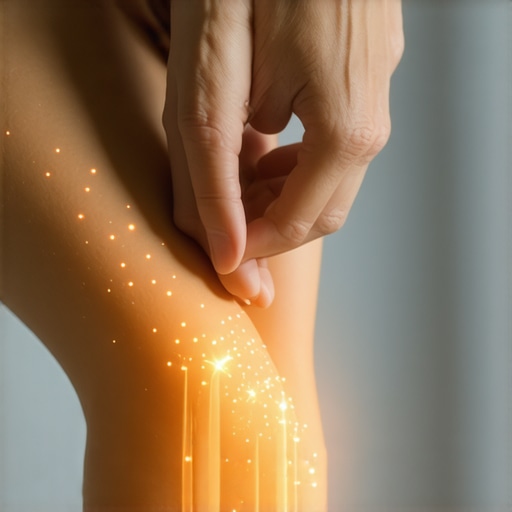
I remember the exact moment I realized my “funny bone” feeling in my thigh wasn’t funny at all. I was reaching for a coffee mug when my right leg simply gave out, sending me stumbling into the kitchen counter. For months, I’d been telling myself I just needed a better chair or that I was sitting “wrong.” I even tried to stretch my hamstrings away, which—spoiler alert—made everything ten times worse because I was actually yanking on an already irritated nerve. We’ve all been there, shaking out a foot that’s fallen asleep, but when that tingling starts sticking around like an uninvited houseguest, your body is trying to tell you something. Today, I’m going to help you decipher those signals so you can stop guessing and start fixing the root cause.
That Tingle Might Be More Than Just a Sleeping Foot
I used to think all numbness was created equal. I was wrong. My biggest mistake early on was assuming that if I didn’t have sharp, stabbing back pain, my leg issues couldn’t possibly be spinal. I spent a fortune on fancy cushions while my nerve pressure was actually screaming for a real adjustment. If you’re feeling a persistent “buzzing” or a patch of skin that feels like leather, you might be dealing with more than poor circulation. According to the Mayo Clinic, when numbness is accompanied by sudden weakness or a change in bowel or bladder function, it’s no longer a “wait and see” situation but a medical emergency. For the rest of us, it’s often a slow-motion car crash of posture and spinal alignment. Have you ever felt like your leg was heavy or “dead” even after you stood up and walked around?
Is this just another thing I have to worry about?
It’s easy to feel skeptical or even a bit panicked when your body starts acting up. You might worry that this means surgery or a lifetime of restricted movement. I felt that same fear when I realized how to tell if your sciatica is coming from your piriformis rather than a herniated disc. The truth is, most leg numbness is a solvable puzzle. It’s often about relieving the “kink in the garden hose” that is your nervous system. Whether it’s a simple nerve trick for your desk or finally addressing a leg length difference, getting to the bottom of the sensation is the first step toward moving without that constant shadow of discomfort. Let’s look at the specific red flags that separate a minor annoyance from a serious structural issue.
Resetting Your Neural Highway
To fix leg numbness, you have to stop treating your body like a collection of tight rubber bands and start treating it like a delicate, high-voltage electrical grid. When a nerve is compressed, it’s like a kink in a wire; pulling on that wire from both ends just makes the connection worse. The goal isn’t to yank the muscle but to decompress the space where the nerve lives. I remember my first real breakthrough happened when I stopped trying to ‘overpower’ the numbness and started listening to the subtle resistance in my joints.
Stop Pulling and Start Gliding
Nerves do not have the same elasticity as muscles, so they don’t respond well to traditional stretching. They like to ‘glide.’ Think of a nerve like a silk thread inside a straw; if the thread gets snagged, pulling on it just creates tension. Instead, you want to move the thread back and forth through the straw to clear the snag. I remember sitting on my living room floor, skeptical, as I performed my first nerve glide. I moved my ankle and neck in a synchronized rhythm. It felt like a strange ‘zing’ at first, but within ten minutes, the heavy sensation in my thigh started to lift. This is the hidden nerve trick to stop leg tingling while sitting at your desk that shifts the focus from muscle tension to neural mobility. 
The Standing Error That’s Crushing Your L5 Disc
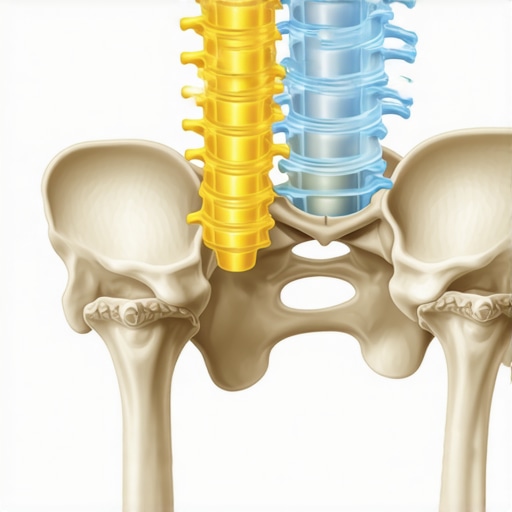
Many of us try to solve leg numbness by switching to a standing desk, but standing incorrectly can be just as damaging as sitting. There is a common standing error that puts 50 pounds of pressure on your l5-s1, which is the most frequent site of nerve impingement. I used to ‘hang’ on my hip joints and lock my knees, essentially using my spine as a kickstand rather than a support column. To fix this, you must maintain a micro-bend in the knees and keep your weight centered over your arches, not your heels. This simple shift prevents the vertebrae from pinching the nerves that travel down into your feet.
Target the Psoas Without Making It Angry
Sometimes the pinch isn’t in your back at all, but deep in your pelvis. Your psoas muscle runs right past major nerve pathways, and if it’s chronically tight, it acts like a vice grip. However, you have to be careful; why stretching your psoas might actually be making your back hurt more is a lesson I learned the hard way. I once tried to ‘stretch’ through the pain with deep lunges, only to find my leg felt even more numb the next day because I was over-sensitizing the femoral nerve. Instead, use the one move that fixes a tight psoas muscle by focusing on a gentle, isometric release. When combined with the simple pelvic tilt that makes sitting for hours painless, you create a structural environment where nerves can finally function without interference.
We’re often told that if our back hurts, we just need to get stronger. I spent years doing planks until my face turned purple, only to realize that why your core strength isn’t stopping your back aches is actually because of a phenomenon called ‘over-bracing.’ Dr. Stuart McGill, a leading expert in spine biomechanics at the University of Waterloo, has shown that excessive abdominal stiffening can actually increase the compressive load on your discs rather than protecting them. It’s a classic case of too much of a good thing. Instead of turning your torso into a rigid block of concrete, you need dynamic stability—the ability to respond to movement without locking up. Have you ever felt like you were ‘holding’ your breath just to stand up straight? This is a huge red flag that your nervous system is on high alert and overcompensating for a lack of true mastery over your mobility.
Why does my pain move from side to side?
It’s incredibly frustrating when your left leg goes numb one day, and then the next morning why your sciatica pain changes sides becomes the new mystery you have to solve. This usually happens when the issue is central to the spine or related to a shifting disc bulge. One of the biggest ‘oops’ factors I see is people trying to ‘stretch it out’ using the 90-90 position. If you aren’t careful, the 90-90 hip stretch mistake that is hurting your lumbar spine can actually torque your pelvis and irritate the very nerves you’re trying to soothe. You aren’t just moving bone and muscle; you are moving sensitive neural tissue that doesn’t like to be pulled on when it’s already inflamed.
Then there’s the ‘aesthetic’ trap. Many of us were taught to ‘stand tall’ by pulling our shoulders back and sucking in our guts. But why you should stop sucking in your stomach to look thinner is a lesson in internal pressure management. Constant tension in the upper abs prevents the diaphragm from dropping properly, forcing your neck and back muscles to do the work of breathing. This leads to a cascade of issues that only resolve once you implement posture correction secrets that transform back pain outcomes by focusing on relaxation rather than rigidity. Have you ever fallen into this trap? Let me know in the comments. I’d love to hear if chasing ‘perfect posture’ has actually been making you feel more stiff than supple.
Once you stop the ‘bleeding’—meaning you’ve addressed the acute numbness and immediate tingling—the real work of maintenance begins. I don’t believe in buying every gadget advertised on social media, but a few specific tools and adjustments changed the game for me. For instance, I stopped using my laptop on flat surfaces entirely. I realized my eyes were dictating my posture, so I implemented the 2-inch rule for your laptop stand to keep my neck neutral and prevent that cascading pressure on my lower spine. I also swapped my standard keyboard for a split version; this simple change to your keyboard stops shoulder pain by preventing the internal rotation that eventually tugs on your mid-back nerves.
How do I keep my nerves happy for the long haul?
Maintenance isn’t about hour-long corrective workouts; it’s about micro-adjustments that respect your anatomy. I use a specific chair hack to keep my pelvis neutral while I’m writing, and I never sit without a small footrest anymore. If you’ve never tried it, learning how to use a footrest to save your lower back is a total epiphany for people with shorter legs or deep chairs that force the spine to ‘hammock.’ These small physical barriers prevent the very slouching that leads to that familiar, frustrating leg tingle.  Looking forward, I predict we are going to see a massive shift toward haptic biofeedback wearables. Instead of just tracking steps, we’ll have sensors that vibrate when our L5-S1 pressure exceeds a certain threshold. Until that tech becomes mainstream, we have to be our own sensors. According to a 2015 study published in the Journal of Physical Therapy Science, even a 15-degree forward head tilt can double the effective weight of your head on your spine, creating a chain reaction that ends in your lumbar discs. This is why I swear by the 30-second wall reset. It recalibrates your internal ‘level’ and tells your nervous system that it’s safe to let go of that protective tension. I want you to try this right now: stand against a flat wall, with your heels, glutes, and head touching the surface, and just breathe into your lower back for 30 seconds. It’s the fastest way to unlock better back health without needing a single piece of fancy equipment or a gym membership.
Lessons Your Nerves Want You to Learn Before It Is Too Late
If I could go back to that first morning my leg felt like lead, I’d tell myself to stop looking for a ‘quick pop’ and start looking for a sustainable rhythm. The biggest mistake we make is treating our nerves like they are just another muscle to be conquered. Your nervous system is a sensor, not a weight to be lifted. I learned that the morning movement routine that lubricates your joints is worth more than a dozen heavy deadlifts when your discs are already under fire. I also realized that ‘good’ posture isn’t a rigid pose—it’s the absence of unnecessary tension. When you learn how to breathe into your lower back to release tension, you are essentially giving your nerves the oxygen and space they need to stop sending those frantic tingling signals.
The Tools I Use to Keep My Spine in Check
You don’t need a thousand-dollar setup to fix your back, but you do need intention. My personal toolkit starts with a simple, high-quality footrest because it changes the entire angle of my pelvis while I work. I also had to get real about the truth about posture correctors and braces; they can be a helpful training wheels phase, but they aren’t the final answer. For me, the real game-changer was finding the best sleeping position for chronic si joint pain relief. If you aren’t recovering while you sleep, you’re just starting every day at a deficit. These tools aren’t just gadgets; they are structural boundaries that protect your L5-S1 disc from the grind of daily life.
Walk Toward a Life Without Constant Numbness
Taking the first step toward unlocking better back health can feel overwhelming, but remember that your body is incredibly resilient. You aren’t ‘broken’; you’re just slightly out of alignment. Every time you choose to adjust your monitor height or take a 30-second break to reset, you are rewriting your body’s electrical blueprints. By committing to mastery over your mobility, you are choosing a future where you can reach for that coffee mug—or pick up your kids—without that nagging fear of your leg giving out. You’ve got the knowledge now; all that’s left is the practice. Have you ever noticed your leg numbness gets worse after a long day of sitting, or does it strike you first thing in the morning? Let me know in the comments below.