

I remember sitting on a tattered weight bench three years ago, staring at a pair of heavy dumbbells and feeling absolutely defeated. I had just finished a grueling back day, yet my mid-back felt like a stack of wet napkins. I was objectively ‘strong’ by gym standards, but five minutes at my desk later, I was back to a pathetic, rounded slump. It felt like I was building a grand house on a foundation of shifting sand. I thought I was training hard, but in reality, I was just teaching my body how to move weight while completely ignoring the ‘dead zone’ between my shoulder blades. The burn was constant and localized—a hot, nagging sensation that made me want to lean against a doorframe every hour just to feel some relief.
Your Muscles Are Moving But Your Mid-Back Is Hiding
I spent way too long making the classic mistake of thinking that strength was purely a numbers game. I added more plates to the row machine and more reps to the pull-ups, yet the weakness persisted. This was my big ‘lightbulb moment’: I was strengthening my big, prime-moving muscles like the lats, while my deep stabilizers were essentially on a permanent vacation. If you have ever experienced that stuck feeling in your mid-back, you know it isn’t about lack of effort; it’s a lack of connection. According to Harvard Health, muscle imbalances often stem from ‘sensory-motor amnesia,’ where the brain actually loses the ability to recruit specific muscle fibers due to repetitive stress or poor posture. This explains why your core strength isn’t stopping your back aches. You can have a six-pack and still have a spine that feels like it’s collapsing under its own weight because the communication lines are down. I had to stop trying to overpower the pain and start learning how to actually inhabit my own ribcage again.
Is my spine permanently stuck like this?
It’s a scary thought when you’re staring in the mirror at a rounded upper back that won’t seem to straighten out no matter how much you ‘pull your shoulders back.’ You start to worry that maybe you’ve got ‘bad’ genetics or that a decade of office work has fused your vertebrae into a permanent question mark. Trust me, I’ve been in that headspaces, wondering if I was destined for a lifetime of heat pads and ibuprofen. But here is the promise: your body is incredibly plastic. We aren’t going to just throw more heavy exercises at the problem today. Instead, we are going to dive into why your upper back burns after using a mouse and how something as small as a shoulder blade squeeze can do more for your posture than a 300-pound deadlift. Have you ever felt like your back is ‘exhausted’ even on a day when you haven’t stepped foot in the gym? That is the specific mystery we are going to solve right now.To break out of that ‘stuck’ feeling, you have to treat your spine like a frozen computer that needs a hard reboot. You can’t just wish your way into better posture; you have to physically reintroduce your nervous system to the muscles that have gone dormant. The first step isn’t about lifting heavy weights—it’s about positional awareness and recalibrating your internal map of where your shoulders actually belong.
Reclaim Control with the Wall Reset
Most of us spend our lives in a ‘forward’ world, reaching for phones, keyboards, and steering wheels. This creates a mechanical disadvantage where your chest muscles are pulling your shoulders forward, turning your upper back into a stretched-out, weakened bowstring. To fix this, you need to use a flat surface as your feedback loop. Stand against a wall with your heels, glutes, and head touching the surface. This is where the magic happens: the wall angel move that reverses a day of hunching is the gold standard for diagnostic and corrective movement. I remember the first time I tried this. I was so tight that my wrists wouldn’t even touch the wall without my lower back arching six inches off the drywall. My arms were shaking like a leaf in a hurricane, and I realized my ‘strength’ was a total illusion. I wasn’t just stiff; my brain had forgotten how to retract my scapula without compensation. 
Force Your Upper Back to Do Its Job
The goal here is to slide your arms up and down the wall in a ‘W’ shape while keeping every point of contact—wrists, elbows, and back—firmly pressed against the surface. If you feel a sharp burn or can’t keep your arms back, you’ve identified your ‘dead zone.’ This isn’t a failure; it’s a roadmap. By performing a shoulder blade squeeze at the bottom of each rep, you are essentially screaming at your rhomboids and middle trapezius to wake up. This is how you begin moving without pain again—by building the endurance of these small stabilizers so they don’t give up on you by 2:00 PM.
Why Your Computer Screen is Your Biggest Enemy
You can do all the wall angels in the world, but if you go back to a desk where your head is tilted down for eight hours, you’re just pouring water into a leaky bucket. Think of your head like a 10-pound bowling ball; for every inch it tilts forward, it adds 10 pounds of effective weight to your neck and upper back. This is exactly why your laptop screen height is killing your upper back. I used to work on my laptop at the kitchen table, wondering why I felt like I was wearing a lead vest. The fix was embarrassingly simple: applying the 2-inch rule for your laptop stand to get the monitor at eye level. This small adjustment shifts the load from your soft tissues back onto your skeletal structure, where it belongs. When your bones support your weight, your muscles can finally stop acting like emergency cables and start acting like movers again. This is the foundation of posture correction secrets that actually stick.I used to think that if a muscle felt tight, the only solution was to stretch it until it surrendered. I’d spend twenty minutes a day hanging off the edge of my bed or pulling my arms across my chest, yet the relief lasted about as long as a cup of coffee. Here’s the hard truth: most people are actually over-stretching muscles that are already ‘locked long.’ When you sit at a desk, your rhomboids and middle traps are being pulled apart like a rubber band stretched to its limit. They feel tight because they are under constant tension, not because they are short. If you keep stretching them, you’re just making the rubber band thinner and more likely to snap. This is a massive ‘oops’ factor I see in the gym every day. Instead of more flexibility, you need to focus on how to enhance flexibility through active engagement rather than passive pulling.
Why does the tension return five minutes after an adjustment?
It’s incredibly frustrating to leave a session feeling like a new person, only to have that familiar knot creep back in before you even get home. This happens because your nervous system is addicted to your old, dysfunctional patterns. A study published in the Journal of Bodywork and Movement Therapies highlights that without ‘neuromuscular re-education,’ the brain defaults to the most energy-efficient path—which is usually your slumped-over habit. This is why self-cracking your neck makes the stiffness come back faster; you’re providing a temporary sensory distraction without changing the underlying movement map. To make it stick, you have to pair those daily adjustments to alleviate back pain with specific, resisted movements that tell your brain, ‘This new position is the safe one.’
Ditch the Braces and Build Your Own Support
One of the biggest traps you can fall into is the ‘posture corrector’ craze. I’ve seen people strap themselves into these elastic harnesses, thinking they’re solving the problem. In reality, the truth about posture correctors and braces is that they act like a cast for a broken arm—they let the muscles underneath atrophy even further. You’re essentially outsourcing your stability to a piece of cheap velcro. The moment you take it off, your spine collapses because your internal ‘guy wires’ have forgotten how to work. #IMAGE_PLACE_HOLDER_C#
Can a tight hip really cause a knot in my shoulder?
Absolutely. Your body is a single kinetic chain. I spent years ignoring my lower half, only to find out that stretching your psoas might actually be making your back hurt more if you aren’t stabilizing your pelvis. When your hips are locked, your mid-back has to over-rotate and over-compensate to keep you upright. It’s all connected. Have you ever fallen into this trap of focusing only on where it hurts while ignoring the rest of your body? Let me know in the comments if you’ve been ‘stretching’ the same spot for months with no results. We need to look at posture correction secrets that involve the whole system, not just the symptom. You have to stop treating the smoke and start looking for the fire.To stop the cycle of recurring knots and that nagging ‘stiff’ feeling, you have to transition from a ‘fix it’ mindset to a maintenance mindset. I used to think I could just do one big session and be good for a month, but that’s like trying to brush your teeth for two hours on a Sunday and expecting to skip the rest of the week. Real progress happens in the mundane gaps between your big workouts.
The Tool That Saved My Spine Was Under My Feet
If you want to fix your back, you have to look at where you meet the ground. I keep a high-density lacrosse ball under my desk at all times. This isn’t just for foot massages; it’s a primary tool for kinetic chain management. When you learn how to use a tennis ball to release tension in your feet and back, you are addressing the literal foundation of your posture. I personally use a harder lacrosse ball because the fascia on the bottom of the feet is incredibly tough. By rolling out the plantar fascia for two minutes every morning, I found that my hamstrings felt looser, which in turn stopped my pelvis from tucking under and straining my L5-S1. This is crucial because what your foot arch says about your chronic hip pain is often the missing link in why your upper back feels so tight. If your base is wobbly, your shoulders will always hike up to compensate.
Build an Environment That Forces Good Habits
You cannot rely on willpower alone. If your desk is set up poorly, you will slump; it is a physical certainty. I transitioned to a setup that incorporates the 30-second wall slide for instant shoulder relief as a mandatory ‘transition’ move every time I finish a meeting. Beyond physical tools, I believe the future of back health lies in real-time biofeedback. We are already seeing a shift toward wearable sensors that provide subtle haptic nudges when your thoracic spine exceeds a certain degree of curvature. In my opinion, within the next three years, we won’t just be looking for expert tips for easier movement in 2025; we will have AI-driven software that adjusts our screen height or lighting to subconsciously influence our seated position.
How do I maintain these postural gains over time?
Consistency over intensity is the golden rule. I recommend the ‘Mirror Check’ method. Every time you get into your car, sit up perfectly straight—ribs down, chin tucked, crown of the head reaching for the roof—and then adjust your rearview mirror to improve your posture. If you find yourself unable to see out of the mirror twenty minutes later, it’s a physical signal that you’ve slumped. This provides an external feedback loop that doesn’t require you to constantly ‘think’ about your back. According to a meta-analysis in the Journal of Orthopaedic & Sports Physical Therapy (JOSPT), targeted myofascial release with small tools significantly improves joint range of motion without the loss of muscle force often seen in long-duration passive stretching. This is why I advocate for mobility mastery through active, short-duration ‘reboots’ rather than hour-long stretching marathons. 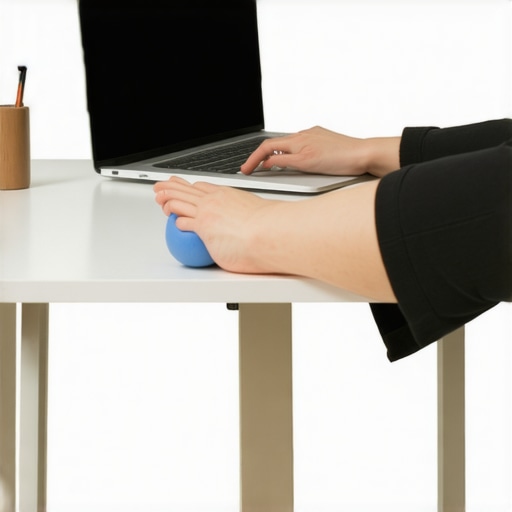 You have to adjust your routine to include these micro-alignments. My challenge to you: tonight, before you go to bed, spend just sixty seconds on a firm surface doing a shoulder blade squeeze and see how much lighter your chest feels tomorrow morning.
Why I Stopped Chasing Temporary Relief for My Back
I spent years thinking I could stretch my way out of a slump, but the biggest lesson I learned was that my brain was the real bottleneck. I realized that your core strength isn’t stopping your back aches because your nervous system is simply stuck in a defensive loop. Here is the insider secret: if a muscle feels chronically tight, it is often weak and overstretched, not short. We keep pulling on the same knots instead of waking up the muscles that are supposed to hold us upright. Also, don’t fall for the trap of external fixes; the-truth-about-posture-correctors-and-braces is that they turn your internal support system into mush. True stability comes from the inside out, not from an elastic harness. Finally, I discovered that my feet were actually controlling my shoulders. When I started addressing what your foot arch says about your chronic hip pain, my upper back tension magically started to melt away because my foundation was finally level.
The Three Simple Tools That Actually Work
You do not need a fancy home gym to reclaim your mobility, but you do need a few high-value items that provide constant feedback. First, keep a high-density ball nearby to learn how to use a tennis ball to release tension in your feet and back. I trust this method because it provides targeted myofascial release that you can control. Second, use any sturdy wall as a diagnostic tool. The 30-second wall slide for instant shoulder relief is my non-negotiable move after every two hours of work. Third, rethink your digital environment. Applying the 2-inch rule for your laptop stand changed my life by moving the load from my neck to my bones. Lastly, use your car as a posture coach by learning how to adjust your rearview mirror to improve your posture. It is a silent, constant reminder to sit tall.#IMAGE_PLACEHOLDER_E#
Take Your First Step Toward Lasting Mobility
Your body is incredibly resilient and capable of change at any age. The rounded shoulders and nagging knots you feel today are not a life sentence; they are just your body’s way of adapting to the environment you’ve given it. By choosing to adjust your routine with small, consistent micro-moves, you are teaching your nervous system that it is safe to let go of that tension. I want you to feel the lightness that comes with true mobility mastery. Don’t wait for the pain to become unbearable before you act. Start with one wall slide, one mirror adjustment, and one deep breath into your ribcage. You deserve a body that moves with ease and a spine that supports your ambitions rather than limiting them. Have you ever tried using a posture brace only to find that the stiffness returned the moment you took it off? Let me know your experience in the comments below!