
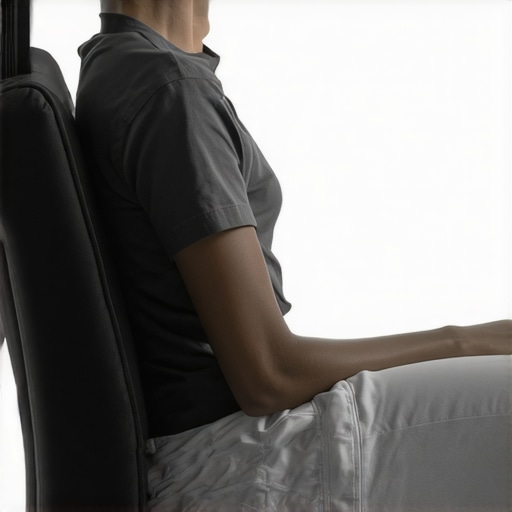
I remember the exact moment my back decided it had finally had enough of my “ergonomic” help. I was sitting in my home office, feeling quite smug because I’d just strapped a brand-new, firm lumbar roll to my chair. I thought I’d finally solved the mystery of my afternoon aches. Ten minutes later, I reached for a glass of water and—BAM. My lower back locked up so hard I couldn’t draw a full breath. It felt like a hot poker was being driven into my spine. I wasn’t just uncomfortable; I was physically trapped by a muscle spasm that didn’t care about my $30 foam log. This was my big wakeup call: more support isn’t always better support.
Your lumbar roll shouldn’t feel like a torture device
The biggest mistake I made early on was thinking that if a little arch was good, a giant arch must be better. I forced my spine into this exaggerated, rigid curve that actually put my muscles on high alert instead of letting them relax. We’ve been told that lumbar rolls are the holy grail of office health, but the truth is a bit messier. When you shove a hard roll into your small of the back without a plan, you might be overextending your facet joints. If you are currently in the middle of a flare-up, you really need to know how to use heat and ice correctly for back spasms before you try to fix your chair again. Today, we are going to debunk the myths about these rolls and find the middle ground that actually keeps your discs happy without triggering a muscular mutiny. According to Harvard Health, while lumbar support is vital, an improperly placed support can actually increase intradiscal pressure rather than relieving it. I learned that the hard way by ignoring the subtle signals my body was sending before the big spasm hit. I was so focused on “correct” posture that I forgot to listen to my own comfort. Have you ever felt that terrifying ‘catch’ in your back just seconds after adjusting your support cushion? It’s a sign something is fundamentally off.
Is a rolled-up towel actually safer than a fifty dollar cushion?
I used to think the more I spent on a gadget, the better my back would feel. That’s just not true. Sometimes, the most effective tool is a simple household item that allows for micro-adjustments. I eventually ditched my hard foam roll for the simple towel trick for stiff morning necks and adapted it for my lower back. This allowed me to control the thickness and the firmness, which is something a store-bought roll rarely lets you do. By focusing on unlocking better posture through simple adjustments, I realized that my back needed breathing room, not a permanent brace. This is especially true when you are traveling; for instance, knowing the proper way to sit in a car for long road trips often involves less equipment and more awareness of how your pelvis is tilted. We’re going to look at why your muscles are reacting with such violence and how to calm them down so you can actually sit through a movie or a meeting without fearing the next spasm.
Find the apex of your arch first
Most people treat a lumbar roll like a backstop in a parking lot; they just shove it down until it hits the seat. That is exactly how I ended up horizontal on my office floor three years ago. To find where that support actually needs to live, you need to identify the natural hollow of your back, usually right around the level of your belly button. Think of your spine like a suspension bridge. If the support is too low, it pushes your pelvis forward into a slump; if it is too high, it creates a ‘shelf’ that forces your upper back to round. I found that by sliding a small roll up and down while sitting, there is one specific millimeter where my shoulders naturally drop and my head feels lighter. This is the goal of finding the apex. You want to adjust your routine daily spinal alignments for lasting relief by making sure that roll is supporting the curve, not forcing a new one.
The rolled-up towel trick saves your discs
If you find that store-bought cushions are too aggressive, go back to basics. I spent three weeks trying to ‘break in’ a high-density foam roll only to realize my spine was the one breaking. I switched to a medium-sized hand towel, rolled tightly and secured with two rubber bands. This gave me the ‘squish’ I needed. This softer approach is essential because your spine isn’t a static object; it needs to move slightly even when supported. When I first tried this during a four-hour writing session, I noticed I didn’t have that ‘stiff as a board’ feeling when I finally stood up. This subtle change in equipment is a cornerstone of how to adjust your routine daily spinal alignments for lasting relief. It provides a gentle nudge to the vertebrae rather than a shove. Pair this with knowing how to use a footrest to save your lower back at work, and you create a tripod of stability that doesn’t rely on brute force.
Use your breath as a built-in sensor
Here is the litmus test for any lumbar support: can you still take a full, deep breath into your belly? If the roll is too thick or placed incorrectly, your abdominal muscles will subconsciously brace to protect your spine, which restricts your diaphragm. I used to think a tight, rigid core was ‘good posture,’ but it actually keeps the nervous system in a state of high alert. If you feel like you are breathing mostly in your chest, the roll is likely too large. You must learn how to breathe into your lower back to release tension while the support is in place. If the towel or cushion prevents that expansion, it’s doing more harm than good. I remember sitting in a seminar once, feeling my lower back starting to throb. I realized I was holding my breath because my lumbar support was so thick it felt like a fist in my back. As soon as I flattened the support, my breath returned, and the ache vanished within minutes. Understanding why your breath is the key to releasing spine tension allows you to self-correct in real-time without needing a mirror or a doctor.
I’ve seen people spend hundreds on high-end ergonomic chairs only to end up more miserable than when they sat on a wooden kitchen stool. The trap we all fall into is believing that posture is a static position you ‘lock’ into. In reality, your spine is designed for movement, not rigged suspension. If you rely too heavily on that lumbar roll, your deep stabilizers—the tiny muscles that actually keep your vertebrae aligned—start to slack off. This is precisely why your core strength isnt stopping your back aches despite all those planks you do. You’re teaching your body to rely on an external prop rather than internal stability.
Stop trying to find the one perfect sitting position
Everyone tells you to sit up straight with your shoulders back, but in my experience, chasing a ‘perfect’ posture is the fastest way to trigger a muscle spasm. A study published in the Journal of Physical Therapy Science suggests that postural variety—meaning the frequency of change—is far more effective for reducing musculoskeletal pain than any single ‘correct’ sitting position. This means your lumbar roll should be a gentle guide, not a kickstand. If you stay in one ‘perfect’ spot for three hours, your circulation drops and your tissues stiffen. You need to master your mobility by shifting your weight and changing your hip angle every twenty minutes, regardless of how expensive your cushion is.
Can you actually over-correct your spine into a new injury?
The short answer is yes. The ‘oops’ factor usually happens when someone uses a roll that is too firm, forcing the lumbar spine into excessive lordosis (an over-arched back). This puts immense pressure on the facet joints at the back of your vertebrae. If you’ve noticed why your lower back clicks when you stand up from a chair, you might be over-extending your spine throughout the day. I made this mistake for months, thinking I was being ‘good’ by arching my back, only to realize I was grinding my joints together. Your support should feel like a suggestion, not a mandate.
The danger of learned helplessness in your spinal muscles
When you use a rigid brace or a massive lumbar roll, your brain stops sending signals to the multifidus muscles that support your discs. This is why you feel ‘wobbly’ or fragile after a long day at the desk. Instead of just propping yourself up, you should focus on posture correction secrets that transform back pain outcomes by engaging your muscles actively. This involves periodically pulling your belly button slightly toward your spine and feeling your own muscles take the weight off the roll. If you find that why your glutes go to sleep after one hour of sitting is a constant problem, it’s a sign that your support is doing too much of the work for you. We want to use the roll to remind the body where ‘home’ is, not to replace the body’s own structural integrity.
How do you know if your adjustments are actually working?
The real test isn’t how you feel while sitting; it’s how you feel the moment you stand up. If you have to ‘unfold’ yourself slowly or if you feel a sharp catch in your hip, your setup is likely too aggressive. By implementing unlocking better posture through simple adjustments, you should be able to transition from sitting to standing without that 30-second period of stiffness. True spinal health comes from a balance of external support and internal awareness. Have you ever fallen into the trap of buying a ‘fix-it’ gadget that actually made your back pain worse? Let me know in the comments below, and let’s troubleshoot those ergonomic myths together.
Don’t trust your chair to do your job for you
I eventually realized that no amount of fancy mesh or adjustable armrests could replace the ‘active’ part of my recovery. My go-to tool now isn’t a gadget; it’s a simple 25-minute interval timer on my desktop. I’ve found that the best exercises for people who sit all day only work if you actually do them before the pain starts. When my timer goes off, I perform the 10-second posture check to do every time you check your phone. It’s a small friction-point that prevents my lumbar spine from turning into a static, compressed mess. Dr. Stuart McGill, a world-renowned spine biomechanics expert and author of Back Mechanic, often talks about ‘spinal hygiene’—the notion that small, repetitive movements like how you lean over a desk are more impactful than a one-hour workout once a week. I’ve taken this to heart by using the 3-minute desk stretch that targets your psoas as my secret weapon during lunch breaks. It keeps my pelvis from locking into that dreaded forward tilt that ruins my afternoon.
How do I keep my spine from sliding back into old habits?
Maintenance is where most of us fail because we wait for the ‘ouch’ to react. I shifted my focus to a long-term strategy of mobility mastery and simple exercises to relieve chronic back pain. This means every single morning, before I even pour a coffee, I go through the morning movement routine that lubricates your joints. It’s about five minutes of work that sets the tone for my discs. If I skip it, I can feel the difference by 2 PM. I also keep a second ‘travel’ towel in my car because the proper way to sit in a car for long road trips requires different support than my office chair. By treating my back like a high-performance machine that needs daily tuning rather than a broken part that needs a permanent fix, the results have become permanent.
The future of back health is proactive and invisible
Looking ahead, I suspect the era of the bulky lumbar cushion is ending. We are moving toward ‘smart’ environments where haptic feedback and wearable sensors will nudge us into better alignment before we even feel a twinge. Imagine a shirt that gently vibrates when your shoulders round or an office chair that micro-adjusts its firmness based on your fatigue levels. Until those become mainstream, you need to unlock better back health with effective posture tips for 2025 that rely on your own body awareness. I’m already seeing people ditch the ‘ergonomic’ labels for minimalist setups that encourage movement. I want you to try something today: swap your store-bought lumbar roll for a medium-density hand towel for the next two days. Focus on adjusting your routine daily spinal alignments for lasting relief by finding that ‘sweet spot’ yourself rather than letting a manufacturer decide where your curve should be. You might find that the cheapest tool in your house is the one that finally breaks the cycle of spasms.
The Lessons My Spasms Taught Me About True Support
Looking back at years of struggle, there are a few things I wish I’d grasped sooner. First, the quality of your movement matters more than the density of your cushion. You can sit in a three-thousand-dollar throne, but if you don’t adjust your routine daily spinal alignments for lasting relief, you are still fighting an uphill battle against gravity. Second, pain is a messenger, not an enemy to be silenced with more gear. When my back would lock up, I used to get angry; now, I see it as a loud signal that my nervous system is overstimulated by a static position. Finally, stop looking for a ‘fix’ and start looking for a ‘rhythm.’ Real posture correction secrets that transform back pain outcomes are found in the small, consistent habits rather than a one-time gadget purchase. I learned that my back actually preferred the freedom of a thin towel over the rigidity of a ‘perfect’ foam roll.
The Three Low-Tech Essentials I Use Every Single Day
I don’t keep many gadgets in my office anymore, but these are the non-negotiables that kept me out of the physical therapist’s office this year. I always have a medium-weight cotton hand towel nearby; it is infinitely more versatile than any lumbar roll I’ve ever owned because it adapts to my daily inflammation levels. I also highly recommend the book Back Mechanic by Dr. Stuart McGill. It changed my perspective on core stability and disc hygiene entirely. To keep things moving, I use a simple 25-minute interval timer on my phone to remind me to perform the 3-minute desk stretch that targets your psoas before my hips lock up. These tools help you maintain better back health with effective posture tips for 2025 without making you feel like you’re chained to a medical device.
#IMAGE_PLACEHOLDER_E#
Your Daily Routine is Your Best Healing Tool
You don’t need a perfect ergonomic setup to start feeling better today; you just need a willing body and a bit of curiosity about how you move. Remember that any lumbar support should be a temporary guide to help you find your center, not a permanent brace that lets your muscles go to sleep. By focusing on your adjustments, posture, mobility, and back pain management as a holistic, daily project, you will find that the morning stiffness starts to fade and the afternoon fatigue disappears. Don’t be afraid to experiment with the towel trick or to change your seat height multiple times throughout the day. Your spine is incredibly resilient when you stop trying to ‘lock’ it into place and start giving it the variety it craves. Have you ever bought an expensive ‘ergonomic’ chair or pillow that actually made your back pain worse? Let me know in the comments below!